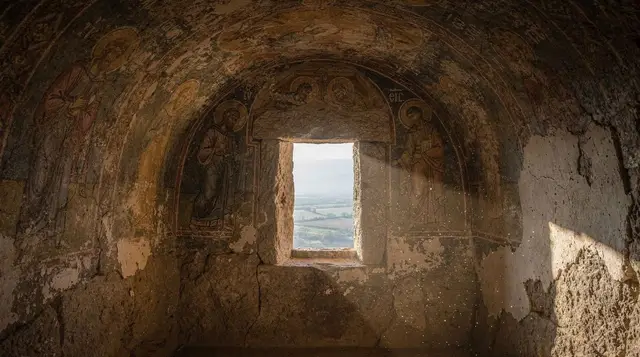
The Avanos hair museum, a curiosity inside a pottery cave
What is the Avanos hair museum?
It's a small chamber inside a working pottery cave in Avanos where the walls and ceiling are covered in thousands of labelled locks of hair, left by women who visited over several decades. It began as one potter's personal collection rather than a planned exhibit, and it's a separate stop from a standard pottery workshop, even though both are usually visited on the same call.
A cave wall covered in hair, and nothing else quite like it
Most oddities on a Cappadocia itinerary are geological or historical: a cave church, a collapsed village, a canyon. The Avanos hair museum is neither. It’s a small chamber cut into the rock inside a working pottery cave, and every surface of it, walls and ceiling alike, is covered in locks of hair. Each one is tagged, usually with a name written on a scrap of paper pinned or taped alongside it.
There are no display cases, no interpretive panels, and no attempt to make the room feel like a conventional museum. That’s part of what makes it memorable, and part of why it’s worth understanding correctly before you go: it isn’t the same stop as a pottery workshop, even though the two usually sit in the same building and get visited back to back.
This page covers the hair museum on its own terms: what it is, how the collection is generally understood to have started, what a visit actually involves, and how it fits into a wider stop in Avanos. If you’re looking for guidance on the pottery itself, the wheel demonstrations, the workshops where you can try shaping clay, and what to expect from buying a piece, that’s covered separately in the Avanos pottery workshops guide, and this page won’t repeat it.
How the collection is said to have begun
The story told locally, and repeated by most guides who bring visitors through, is that one of Avanos’s potters began keeping a lock of hair from women who visited his workshop, pinning each one to the cave wall with a note bearing her name. What started as an informal, personal habit accumulated over years into the dense covering of hair seen today, spreading across the walls and up onto the ceiling of the chamber as more and more visitors added to it.
It’s worth being honest about the limits of that story: there’s no verified count of how many locks are actually pinned up, and no securely documented date for when the practice began. Numbers you might see quoted elsewhere for either should be treated as rough claims rather than fact, and this page won’t repeat one as if it were settled.
What can be said more confidently is that the collection grew organically rather than being planned as an exhibit from the outset, and that it has become one of the more talked-about small stops on an Avanos visit precisely because it’s unusual rather than because it’s polished. It sits closer to a personal curiosity that outgrew its original scale than to a museum in the ordinary sense of the word.
What you’ll actually see
The chamber itself is modest in size, cut into the tuf rock like the rest of the workshop around it. Walking in, the effect is immediate: hair covers the surfaces almost completely, in shades from jet black to grey to bright dyed colours, each lock distinguishable from the next mainly by its tag. Some visitors find it striking in an interesting way; others find it unsettling, and that split reaction is fairly normal and worth expecting rather than being caught off guard by.
There isn’t much to read or be guided through once you’re inside. A member of staff from the workshop may point things out or answer questions, but there’s no formal signage explaining individual pieces, no curated sections, and no attempt at a narrative arc. It rewards a slow look around more than it rewards a long stay: most visitors are in and out within ten to fifteen minutes, which is roughly proportionate to what the room offers. If you’re travelling with children, note that the atmosphere can feel odd to some kids and mildly unsettling to others; it’s not dangerous or inappropriate, just a strange visual that’s worth mentioning in advance rather than springing on them.
Some workshops that keep a hair museum chamber still invite women visitors to add a lock of their own hair to the wall if they want to, continuing the practice that built the collection in the first place. This isn’t universal, isn’t expected of any visitor, and shouldn’t be assumed as part of the visit; ask on site if you’re curious, and don’t feel any obligation either way.
Is it a pottery workshop? No, but it usually sits next to one
This is the point most worth being clear about. The hair museum is not a pottery workshop, and a visit to it doesn’t include watching a wheel demonstration, trying to shape clay yourself, or learning about ceramic painting. Those activities, along with the history of Avanos as a pottery town working the red clay of the Kızılırmak river, are covered in the dedicated Avanos pottery workshops guide.
The hair museum chamber is usually attached to or inside a working pottery cave, which is why the two get mentioned in the same breath and are almost always visited together, but they’re separate experiences with separate reasons to exist. A tour or itinerary description that lists “pottery workshop and hair museum” is naming two different things happening at the same stop, not one activity with two names.
If your priority is the craft itself, the wheel, the clay, the chance to try it, you can book a stop built specifically around that, such as an Avanos pottery making and ceramic painting workshop, and treat the hair museum as a short curiosity you glance into along the way rather than the main event. If it’s the oddity itself that draws you, an Avanos tour with hair museum entry and transfers is built with that as an explicit stop, which removes the guesswork of whether a particular workshop you wander into actually has one.
Practical details
| Detail | What to expect |
|---|---|
| Location | Inside a pottery workshop cave near the Kızılırmak riverside in Avanos, not a standalone building |
| Typical visit length | 10 to 15 minutes for the chamber itself |
| Cost | Often free or bundled with a pottery workshop or organised Avanos stop; confirm locally, as this varies by operator |
| Best paired with | A pottery workshop visit and a short walk along the river |
| Suitable for children | Generally yes, though the visual can feel odd to some; worth mentioning in advance |
| Photography | Usually permitted; ask staff first as a courtesy |
Because it isn’t a standalone attraction with fixed hours published anywhere official, opening times track the workshop it sits inside, which in practice means daytime hours through the week, with variation by season and by which workshop you visit. If a hair museum stop matters to you specifically, it’s simpler to book a tour that names it explicitly than to hope the pottery cave you wander into in central Avanos happens to have one; not every workshop in town does.
Fitting it into a visit to Avanos
Avanos rewards a couple of unhurried hours rather than a rushed stop, and the hair museum works best as one short stage within that, not as the reason for the whole trip. A typical sequence looks like a walk along the Kızılırmak river, a stop at a pottery workshop with a wheel demonstration, a look into the hair museum chamber if that workshop has one, and a wander through the shops selling ceramics, onyx, and textiles that cluster in the town centre. The Avanos walking guide lays out that fuller sequence in more detail, and the Kızılırmak river page covers the river itself and the walk along it.
If you’re coming from Göreme, Avanos is a short run, and it’s commonly folded into a wider morning or afternoon that also takes in Çavuşin, Zelve, or Paşabağ rather than being visited on its own. Guided options such as the Zelve Open-Air Museum and Paşabağ tour cover that northern loop without Avanos itself, so check what’s included before assuming a hair museum stop is part of any given itinerary.
For visitors who’d rather see the underground ceramic side of the region’s clay tradition instead of or alongside the hair museum, the Güray Underground Ceramic Museum entry ticket covers a different, more formally curated collection nearby.
Shopping around the hair museum stop
Because it sits inside a working pottery cave, most visitors end up looking at ceramics for sale on the way in or out, whether or not they came for the pottery itself. The same general shopping caution that applies across Cappadocia applies here: prices are negotiable in small workshops, quality varies a great deal between a mass-produced piece and a hand-thrown one, and there’s no obligation to buy anything just because you were shown a demonstration.
The souvenirs worth buying guide and the buying a carpet in Cappadocia guide both cover that terrain in more depth, including how to tell a workshop-made piece from an imported one, and are more useful than anything specific to the hair museum stop for that decision.
If onyx or jewellery gets pushed on you alongside the pottery, which happens occasionally in Avanos’s shop clusters, the onyx and jewellery what to know guide is worth reading before you commit to a purchase. For a wider view of how village markets and workshop towns like Avanos operate day to day, the local markets day by day guide sets useful expectations.
Is it worth the stop
Treated as what it actually is, a five-to-fifteen-minute look into an odd, personally-built collection inside a pottery cave you’re likely visiting anyway, the hair museum is a reasonable, low-cost curiosity. It costs little in time, is often free or already bundled into a stop you’re making for other reasons, and gives you something genuinely unusual to have seen.
Treated as a destination worth arranging a special trip for on its own, it’s a thin reason to cross Avanos: the room is small, there’s little to read or be told, and the appeal is entirely visual and momentary rather than something that rewards an extended visit. The honest recommendation is to see it if you’re already stopping at a pottery workshop in Avanos that has one, and not to build a separate outing around it.
If you’re planning how Avanos fits into a wider day, the Avanos walking guide and the destination page for Avanos are the better starting points; this page exists to make sure you know what the hair museum specifically is, and isn’t, before you get there.
Avanos hair museum: frequently asked questions
What is the Avanos hair museum?
It’s a cave chamber attached to a pottery workshop in Avanos, its walls and ceiling covered in locks of hair left by women visitors, each tagged with a name. It’s a curiosity rather than a formally curated museum.
How did the hair museum start?
The generally told account is that a local potter began keeping locks of hair left behind by women who visited his workshop, pinning each one to the wall with a note. The practice grew over the years into the dense covering seen today. No verified date or count exists for its origin, so treat any precise figure you read elsewhere with caution.
Is the hair museum the same as a pottery workshop visit?
No. The hair museum is a small side chamber, usually seen in a few minutes; a pottery workshop visit is longer and centres on the wheel and clay itself. They’re commonly visited together in the same building but are different activities, and the pottery workshops guide covers the craft side separately.
How much does it cost to visit?
Entry is often free or bundled into a pottery workshop stop or an organised Avanos tour, but this varies by operator. Confirm locally rather than assuming a fixed ticket price applies.
How long does a visit take?
Around ten to fifteen minutes for the chamber itself. Most visitors combine it with thirty minutes to an hour at the adjoining pottery workshop, which is the longer part of the stop.
Can visitors add their own hair to the collection?
Some workshops still invite it, others have scaled the practice back or stopped. It’s not something to expect as a given part of the visit; ask on site rather than assuming it’s on offer.
Is the Avanos hair museum worth visiting?
As a short curiosity attached to a pottery stop you’re already making, yes. As a dedicated outing on its own, it’s a thin reason to cross Avanos, since the room is small and the value is in how unusual it looks rather than in any depth of content.
Where exactly is it in Avanos?
Inside one of the pottery workshops near the Kızılırmak riverside area of town, not a standalone building with its own entrance. Ask your driver or the workshop staff to direct you to the hair-covered chamber specifically, since not every pottery cave in Avanos has one.
Museum & art tours on GetYourGuide
Verified deep-linked GetYourGuide tours. Book through these links and we earn a small commission at no cost to you.
GetYourGuide does not provide a product photo for this activity — the image shows the meeting point, photographed by us.