The Cappadocia valleys nobody walks
Why some paths stay empty
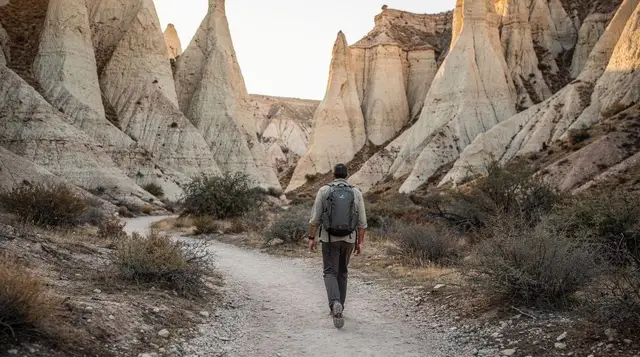
I’ve walked Rose Valley and Red Valley enough times now to recognise the pattern: a steady line of boots on the same red dust, photographers waiting their turn at the same three viewpoints, and a guide’s voice carrying from somewhere just out of sight. Then I’ve turned off onto a side path fifteen minutes later and not seen another person for an hour. Same rock, same light, no crowd.
The valleys I mean aren’t secret. Zemi Valley sits close enough to Göreme that you could walk to it from most hotels, and the far end of Meskendir Valley, past where it meets Rose Valley, is on every hiking map of the region. Parts of White Valley are the same story. None of this is hidden. It’s just not where the feet go.
What actually keeps people out
There’s no mystery here, and I don’t want to pretend there is one. Three ordinary reasons explain it.
First, access. The trailheads for Rose Valley and Red Valley sit near parking areas and viewpoints that every driver and every tour minibus already stops at for the sunset shot. Zemi’s entry point is a scruffier turn-off with nowhere obvious to park, and the quiet stretch of Meskendir starts from a junction that looks, at first glance, like a dead end rather than a path onward.
Second, signage, or the lack of it. Where the popular valleys have worn, obvious tracks and the occasional painted arrow on a rock, these paths thin out and split without warning. You can lose the main line to a goat track in under a minute and not notice for ten.
Third, and this is the one that matters most commercially: no paid site sits at the end of them. Rose Valley funnels naturally toward viewpoints that every tour includes; Red Valley does the same near sunset. Zemi and the quieter reaches of Meskendir and White Valley connect to nothing an agency sells a ticket for, so they never make it onto an itinerary. A tour has to justify a stop, and empty scenery with no shop or church at the end doesn’t clear that bar.
None of that makes these valleys mysterious or unofficial. It makes them inconvenient for a business built around fixed stops, which is a different thing entirely.
Why “nobody walks it” isn’t a reason to go
I want to be direct about this, because I’ve read enough travel writing that treats an empty trail as automatically better. It isn’t, or not simply. Quiet has a cost here, and it’s worth naming before you set off.
There’s no shade worth mentioning. The tuf walls throw a little shelter in a few spots, but for most of the walk you’re exposed, and in July or August that matters more than it sounds like it should. There’s no signage to correct you if you take a wrong branch, and the paths do branch, often toward ledges that go nowhere useful. Nobody maintains these routes the way the museum-adjacent trails get maintained, so loose scree and eroded steps are normal, not an exception. And mobile signal, patchy everywhere in these canyons, is no better here than anywhere else — worse, in practice, because there’s no one nearby to flag down if you need help.
None of this should stop a careful walker. It should stop a casual one. If you’re fit, you tell someone your rough route and return time, you carry water and a downloaded map, and you’re comfortable turning back the moment a path stops making sense, these valleys are well within reach.
If any of that doesn’t apply to you, walk Meskendir Valley as far as its junction with Rose Valley and stop there — you’ll still get most of the scenery without the more exposed sections beyond it. For a fuller picture of what’s involved before you commit, our guide to the best hikes in the region and the hiking safety notes for the valleys are worth ten minutes before you leave the hotel.
If you’d rather not navigate the unmarked stretches yourself, a private guide solves most of the actual risk here, not the scenery, just the getting-lost part. A morning like the private guide day exploring the valleys at your own pace lets you ask a local to route you through the quiet sections without the guesswork.
What I actually walked
My own route started at the edge of Zemi Valley, followed the streambed for around forty minutes without meeting anyone, then cut across to join the far end of Meskendir where it eventually links back up with the Rose Valley crowds. Along the way there were dovecotes cut into the rock with nobody photographing them, a section of old vineyard terracing gone to seed, and long stretches where the only sound was my own footsteps on tuf. It’s a different register from Rose or Red Valley at golden hour, less obviously spectacular, more like being handed the landscape without an audience.
I also spent a shorter afternoon in the quieter folds of White Valley, which rewards patience more than distance: fewer dramatic formations, more of the pale, almost lunar rock that gives the valley its name, and nobody waiting behind you for their turn at the view.
None of this beats Rose Valley at sunset for sheer drama, and I wouldn’t tell a first-time visitor to skip Red Valley in favour of it. What these quiet valleys give you instead is time: the chance to stand somewhere in Cappadocia without another camera in the frame, walk at your own pace, and notice details that a busier path would have you stepping around.
If you value that kind of morning over the more obvious highlight reel, it’s a fair trade. If you’d rather see the balloons drifting over a valley with company nearby, the valleys photo session timed around the balloon flights covers the classic viewpoints instead, and there’s no wrong choice between the two, just a different kind of morning.
Either way, walk carefully, carry water, and don’t mistake an empty path for a safe one just because nobody else thought it was worth the trouble.
Common questions about Cappadocia’s quiet valleys
Where exactly are the valleys nobody walks?
I’m talking mainly about Zemi Valley, which runs close to Göreme but sees a fraction of Rose Valley’s foot traffic; the section of Meskendir Valley past its better-known junction with Rose Valley; and stretches of White Valley away from the handful of spots people usually stop for photos.
Why don’t tour companies include them?
The Red, Green and Blue tours are built around fixed paid stops with parking and toilets. A valley with no ticket booth and no obvious start point doesn’t fit that model, however good the walking is.
Is it safe to walk these valleys alone?
It’s manageable if you’re an experienced, cautious walker who tells someone your route, but it’s not the place to test your fitness or your sense of direction for the first time. There’s no one to ask if a path forks the wrong way.
Do I need a guide for Zemi or White Valley?
Not strictly, but a local guide removes most of the actual risk, mainly getting lost or ending up on a dead-end ledge, and can be arranged through most Göreme agencies for a half-day walk.
Is there any shade or water along the way?
Barely. The tuf walls give patches of shade in places, but there’s no reliable water source and no shop to duck into. Carry everything you need before you set off.
Can I combine a quiet valley with Rose Valley or Red Valley in one day?
Yes, and it’s the easiest way to do this. Walk the busy section first for the views, then branch off into the quiet stretch once you’ve had your fill of other people’s cameras.
What should I carry?
At least a litre of water per person even for a short walk, closed shoes with grip for loose tuf, a downloaded offline map, and a fully charged phone. There’s no shade to speak of and no bin, so pack out what you bring in.
Is mobile signal reliable if I get lost?
No. Signal drops in and out at the bottom of every canyon in this region, quiet or not. Don’t count on calling for directions once you’re off the marked routes near Göreme.
Hiking & nature tours on GetYourGuide
Verified deep-linked GetYourGuide tours. Book through these links and we earn a small commission at no cost to you.
GetYourGuide does not provide a product photo for this activity — the image shows the meeting point, photographed by us.