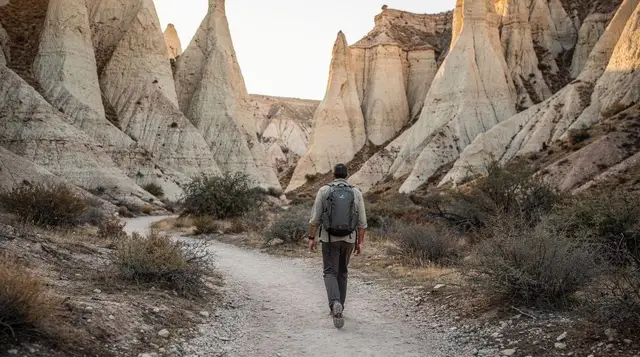
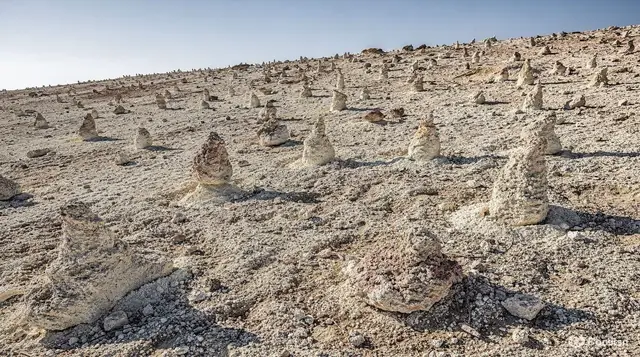
Pale rock, softer light
Most people arrive in Cappadocia primed for red rock. Photos of Red Valley at sunset and the pink cliffs of Rose Valley circulate more than anything else, and after a day or two of touring, the region’s tuf can start to look like a single colour repeated at different times of day. White Valley, known locally as Bağlıdere, breaks that pattern. The tuf here has a noticeably paler, sandier tone than the iron-rich rock of its neighbours, and that single fact changes more than the colour palette of your photographs — it changes how the light behaves.
Iron oxide is what gives Red Valley and Rose Valley their colour, and it also makes those rock faces absorb light, so they deepen towards rust and maroon as the sun drops. White Valley’s tuf has far less of that mineral staining. The pale rock reflects light instead of soaking it up, which means the walls here brighten rather than darken in the last hour or two before sunset. Stand in the valley at that hour and the effect is close to walking through a space lit from the ground up: soft, warm, without the heavy shadow contrast you get among the red cliffs a few kilometres away. It’s a genuinely different atmosphere, not a paler version of the same one.
This isn’t a site to squeeze in as an afterthought to Red Valley. It rewards being visited on its own terms, ideally at the time of day that suits it — which, as it happens, is exactly when the Red Valley viewpoints are at their most crowded with coach groups and tripods. White Valley gives you a quieter version of that golden-hour walk.
Where it actually is
White Valley sits in the cluster of valleys around Ortahisar, roughly 10 minutes from Göreme by taxi or car. The trailhead area overlaps, in a loose geographic sense, with the access points for Meskendir Valley — both are reached from the Ortahisar side of the valley network rather than from Göreme directly — which is part of why visitors sometimes conflate the two.
They are not the same walk. Meskendir follows its own line through the rock with its own character; White Valley branches off separately, with paler stone and a shorter, generally flatter profile. If you’re planning to walk both, treat them as two distinct outings on the map, even if you park in a similar spot and cover them on the same afternoon.
Because the trailhead is closer to Ortahisar than to central Göreme, it’s a natural pairing with a stop at Ortahisar Castle or a slower look around the town itself — see the Ortahisar guide for what else is worth your time there, including the old citrus-storage caves cut into the rock beneath the castle.
Walking the valley
The path through White Valley is one of the easier valley walks in the region: mostly flat, with a few short, gentle inclines where the trail dips around outcrops of rock. Allow 1 to 1.5 hours to walk it at an unhurried pace with stops, less if you’re moving quickly. That makes it noticeably shorter than a full traverse of Red Valley or Rose Valley, and it’s one of the reasons it works well as a second walk in an afternoon rather than the day’s main event on its own.
The surface is the same dry, compacted tuf and dust found throughout the valley network — see the general terrain notes in hiking safety in the valleys, which apply here without exception. That means closed, flat-soled shoes with reasonable grip, not sandals. It also means avoiding the walk immediately after rain: tuf turns genuinely slick when wet, and the packed-dust sections become slippery in a way that isn’t obvious until you’re on them. Give the path a day to dry out after rain before attempting it.
There is almost no shade along the route, which matters more here than the modest length might suggest. In July and August, when afternoon temperatures commonly reach 30–35 degrees, even a 90-minute walk without cover is enough to justify carrying water — a litre per person is a reasonable minimum for the walk alone, more if you’re combining it with other valleys the same day. Mobile signal is patchy once you’re below the rim, as it is throughout the valley network, so don’t rely on it for navigation; the main path is well-trodden enough to follow without a phone, but it does branch, and not every branch leads anywhere useful.
If you’d rather not work out the junctions yourself, or you want to cover White Valley alongside connecting routes with someone who already knows where each branch goes, a guided full-day hike through the national park valleys is the straightforward way to do it without second-guessing the map.
White Valley versus Meskendir Valley
Because the two sit close together near Ortahisar, it’s worth being clear about what separates them rather than treating one as a variant of the other.
| White Valley (Bağlıdere) | Meskendir Valley | |
|---|---|---|
| Rock colour | Pale, sandy tuf | Deeper red and rust tones |
| Typical walking time | 1–1.5 hours | Longer, more varied terrain |
| Access | Ortahisar side | Ortahisar side, separate trailhead area |
| Best light | Late afternoon, low sun | Similar, but the effect reads differently on redder rock |
| Crowd level | Low | Low to moderate |
Neither is a lesser version of the other — they’re two different walks that happen to share a corner of the map. If your schedule only allows one, let the light be the deciding factor: White Valley for the pale, reflective glow described above; Meskendir for a longer walk through redder rock. See the dedicated Meskendir Valley hike guide if that’s the direction you’re leaning.
Why late afternoon is worth planning around
Cappadocia’s valleys all change with the light, but White Valley’s pale rock makes the shift more dramatic than most. At midday, under a high sun, the tuf here can look almost flat and washed out — there’s less colour saturation to begin with, so harsh overhead light does it no favours. Come back two hours before sunset and the same rock takes on a warm, honeyed tone that has more to do with the angle of the light than any change in the stone itself.
This is also a practical scheduling point: the golden-hour crowd in Cappadocia gravitates hard towards Red Valley’s marked sunset viewpoints, which get genuinely busy with tour groups in high season. White Valley, being less on the standard tour-company circuit, gives you a comparable quality of light with a fraction of the foot traffic. If photography is part of why you’re here, see balloon photography spots and the broader Cappadocia viewpoints guide for how this walk fits into a wider plan of where and when to shoot across the region.
Getting there and combining it with other sights
From Göreme, White Valley’s Ortahisar-side trailhead is about 10–15 minutes by taxi or rental car, and the same distance covers Cavuşin and Uçhisar if you want to build a fuller loop around the valley area rather than a there-and-back trip. There’s no dolmuş route that drops you directly at the trailhead, so a taxi, a rental car, or walking in from Ortahisar itself are the realistic options; dolmuş minibuses run reliably to Ortahisar in daytime, from where the valley entrance is a short walk.
A sensible half-day plan: arrive at the trailhead in the mid-to-late afternoon, walk White Valley over roughly 90 minutes as the light softens, then head into Ortahisar itself for a drink or dinner as the sun goes down — the town’s rooftop terraces look back over the valley network you’ve just walked. If you have a full day rather than a half day, pair the walk with a slower look at Ortahisar Castle in the morning before the afternoon light window opens up.
For those staying further out in Ürgüp, the trailhead adds roughly 15 minutes each way compared with a Göreme start, which is still manageable for an afternoon plan built around this walk.
If you’re stitching together a broader hiking day across several valleys rather than treating White Valley as a standalone outing, the best hikes in Cappadocia guide sets out how the various valley walks connect, and the valleys on foot, quad, or horseback guide is worth a look if you’re deciding between walking and one of the other ways people cover this terrain. Anyone building a longer, hiking-focused stay should also check the 4-day hiking itinerary, which slots a walk like this one in alongside the longer valley traverses.
What to look at while you walk
Because the walk is short and the terrain forgiving, you have attention to spare for the details. Watch how the colour of the rock shifts from one bend to the next: in shade the tuf turns a cool cream, and where the sun reaches it, it warms towards gold. Look also at the erosion patterns on the walls, the fluted surfaces and small hollows that rain and wind have carved over a very long time. The story of how this landscape formed is told in the volcanoes that made Cappadocia, and it makes the walk more meaningful once you know what you are looking at.
Keep an eye out, too, for the rock-cut openings that appear in valley walls throughout the region. Many of them are old dwellings, storerooms or dovecotes, and the habit of carving into soft stone runs through everything from Pigeon Valley to the churches described in cave churches and frescoes. You do not need to enter anything to appreciate it; simply noticing how people have lived inside this rock for generations changes the way the valley reads.
Take your time at the places where the path opens out. Those are the natural spots to stop, drink some water and let the light do its work. Resist the urge to rush towards the end of the trail, because the best views often come when you turn around and look back along the route you have just covered.
Making it a slow afternoon
White Valley suits a loose, unforced plan. If you have already spent mornings at the big sights, this is the walk that lets the day breathe. Pair it with the pace described in a slow day in Cappadocia, and resist filling every hour. A late lunch in Ortahisar, the walk as the light lowers, and a quiet evening on a terrace is a complete day in itself.
It also works as a counterweight to the more demanding outings. After a very early start for a balloon flight, a gentle valley walk in the afternoon is far easier on tired legs than a long traverse, and the balloon sunrise timing by season guide helps you plan the two around each other. If you would rather read about the wider picture before committing, Cappadocia in autumn and Cappadocia in spring both describe how the valleys feel in the seasons when this walk is most pleasant.
For travellers who like to see how a short walk fits into a longer trip, the 3-day Cappadocia itinerary and the photography itinerary both leave room for an afternoon like this one. And if the weather turns on you, when the weather turns in Cappadocia is a useful read before you decide whether to go ahead or wait a day.
Booking a guided walk
Most visitors walk White Valley independently — the path doesn’t demand a guide, and the trailhead is easy enough to find from Ortahisar. If you’d prefer company, local knowledge of the branching paths, or you’re combining it with valleys further afield in one outing, a guided full-day walk through the national park valleys covers ground like this alongside connecting routes.
Plenty of visitors also treat a valley walk like this as the daytime complement to a dawn hot air balloon flight over the same landscape, or, for anyone who’d rather stay on the ground at sunrise, a balloon watching tour that takes in the launch fields before the day’s walking begins.
FAQ: White Valley (Bağlıdere)
What makes White Valley (Bağlıdere) different from Cappadocia’s other valleys?
The tuf here is genuinely paler than the red, pink and rust tones found in nearby Red Valley and Rose Valley. Pale rock reflects rather than absorbs light, so the walls glow instead of deepening to rust in late afternoon, which changes the whole feel of the walk.
Is White Valley the same as Meskendir Valley?
No. They sit in the same general area near Ortahisar and their access points are close together, but they are separate routes with different rock colour, different length and different scenery. Treat them as two walks, not one.
How long does the White Valley walk take?
Most people cover it in 1 to 1.5 hours at an easy pace, longer if you stop often for photographs. It is shorter and flatter than Red Valley or Rose Valley.
Do I need a guide to walk White Valley?
No, the main path is straightforward to follow on foot from the Ortahisar side. If you’d rather not navigate the valley network alone, a guided full-day hike through the national park area covers this and connecting valleys with someone who knows the junctions.
Is White Valley suitable after rain?
Not straight after rain. The tuf surface turns slick and the packed-dust sections become slippery, exactly as in every other Cappadocia valley. Wait a day for the path to dry out.
What should I wear to walk White Valley?
Closed, flat-soled shoes with grip. There is almost no shade along the route, so a hat and water matter more than footwear alone in summer.
When is the best time of day to visit White Valley?
The two hours before sunset, when low-angle light picks up the pale rock. Midday washes the colour out and adds unnecessary heat with no shade to escape it.
Can I combine White Valley with other sights in one visit?
Yes. It sits close to Ortahisar and within reach of Meskendir Valley, so a single afternoon can cover the walk, a stop at Ortahisar Castle, and dinner or a drink at one of Ortahisar’s terraces.