The land of beautiful horses: how Cappadocia got its name
What does the name Cappadocia mean?
Cappadocia is usually traced to Katpatuka, a name recorded under Achaemenid Persian rule and often translated as 'land of beautiful horses'. The exact linguistic root is debated, but the plateau's long horse-breeding history is well documented from classical sources onward, and Göreme and Ürgüp still have working stables today.
Where the name Cappadocia comes from
Most guidebooks repeat the line without explaining it: Cappadocia means “land of beautiful horses”. It is a genuinely old claim, not a piece of tourism copywriting invented for Göreme’s hotel brochures, and it is worth setting out properly, because the shorthand version tends to strip out the uncertainty that comes with it.
The name has a documented starting point. Under the Achaemenid Persian Empire, the plateau of central Anatolia that now includes Kayseri, Nevşehir, Niğde and Aksaray was administered as a satrapy, the Persian term for a province, recorded as Katpatuka. The Greeks who wrote about the region from the fifth century BC onward rendered this as Kappadokia. Latin kept the same shape, and English inherited it as Cappadocia. The chain from Katpatuka to Cappadocia is not disputed. What is debated, and has been for a long time, is what Katpatuka itself meant before the Persians used it as an administrative label.
Katpatuka: the oldest recorded name
The standard explanation, repeated in most reference works and most tourist material, is that Katpatuka combines an Old Persian or Luwian root connected to “horse” with a second element meaning something close to “good” or “beautiful”. Put together, that gives the familiar translation: land of beautiful horses, or sometimes rendered as land of fine horses. It is a plausible reading, and it fits everything else known about the region’s ancient reputation, which is one reason it has stuck.
It should be said plainly that the etymology is not settled with certainty. Katpatuka is a name that survives in Persian administrative contexts rather than in a text that explains its own meaning, and very little written material from the region in this period has survived at all. Reputable scholarship treats the “beautiful horses” reading as the most likely and most widely cited derivation rather than as a proven fact beyond dispute. That caveat does not make the story worthless; it just means it should be presented as the leading explanation rather than as an unquestionable etymology carved in stone.
Horses on Anatolia’s high plateau
Whatever the precise linguistic root, the association between this stretch of Anatolia and horse breeding is well attested independently of the name itself. The plateau sits at around 1,000 metres, formed from volcanic tuf thrown out by Mount Erciyes and Hasan Dağı and then worn down over millions of years. Away from the eroded valleys that draw today’s visitors, much of the wider plateau is open grassland and steppe, cold in winter and dry in summer, the kind of terrain that has supported horse pasture across Central Asia and Anatolia for millennia.
The Greek geographer Strabo, writing in the first century, described this part of Anatolia as good horse country and recorded that horses bred here were sent as tribute to ruling powers, a detail that lines up with the plateau’s Persian-era administrative role. Cappadocia’s horses were not a passing detail in his account of the region; they were treated as one of its defining exports, alongside its produce and mineral wealth.
Anatolia’s connection to horse expertise also runs deeper than the Persian period. The oldest surviving horse-training manual anywhere is the Kikkuli text, composed for the Hittite court at Hattusa, roughly 1400 BC, some seven centuries before Katpatuka appears as a Persian satrapy name. It sets out a structured, weeks-long conditioning programme for chariot horses, written in remarkable technical detail for a Bronze Age document.
This does not prove a direct line to the later “land of beautiful horses” etymology, and the two things happened centuries apart under different empires, but it does show that horse knowledge and horse culture in this part of Anatolia predate the Persian administrative name by a long way. The region’s later reputation did not appear out of nowhere.
Cappadocia under Persian rule
Cappadocia’s status as a Persian satrapy lasted from the sixth century BC until Alexander’s campaigns broke Achaemenid control across Anatolia in the fourth century BC. Even after that, the region kept an unusually close relationship with Persian tradition. A local dynasty that claimed Persian royal descent continued to rule Cappadocia as a client kingdom for centuries, longer than most of the territories Alexander’s successors carved up elsewhere in Anatolia. Rome eventually annexed it as a province under Tiberius in 17 AD, ending the client kingdom but not erasing the name, which had already outlived the empire that coined it by several centuries.
This continuity matters for the horse story. A short-lived administrative label attached for a generation or two would be an unlikely source for a name that stuck for over two thousand years. A name tied to a long-running local reputation, reinforced across Persian, Hellenistic, and Roman rule, is a more plausible survivor, and that is roughly what the historical record shows: successive powers governing the plateau, and horse breeding as a recurring, independently noted feature of the place under more than one of them.
Why the landscape suited horses
The connection is not just a linguistic coincidence. The high plateau around modern Nevşehir, Kayseri and Niğde combines several features that favour horse pasture: elevation that keeps summers from becoming unbearable for grazing animals, enough open grassland beyond the eroded valley systems to support herds, and a long history of settled agriculture able to supply grain as well as grass. The volcanic soil that produces Cappadocia’s wine around Ürgüp also supports pasture in the flatter stretches away from the fairy chimney valleys most visitors photograph.
It is worth separating two different landscapes that get blurred together in casual accounts of the region. The narrow, eroded valleys around Göreme, Uçhisar and Zelve are dramatic but not especially useful for grazing; they are a small fraction of Cappadocia’s total area. The wider plateau beyond them, less visited and less photographed, is where the pasture that supported horse breeding would have been. Modern Cappadocia’s tourist image, built almost entirely around the valleys and the balloons that fly over them, easily obscures the much larger agricultural and pastoral plateau that gave the region its ancient reputation in the first place.
A reputation that outlasted empires
By the time Rome absorbed Cappadocia as a province, the name Kappadokia was already old and already fixed. It survived the fall of Rome, the Byzantine centuries when the rock-cut churches around Göreme were carved and painted, the Seljuk and later Ottoman periods, and the modern Turkish Republic, arriving in the twenty-first century essentially unchanged in form since its first Greek transliteration from Katpatuka. Few place names manage that kind of continuity across so many different ruling powers and languages, and it is one more reason historians take the underlying reputation seriously rather than dismissing it as folk etymology invented later to explain the name after the fact.
A present-day echo, not a marketing invention
None of this means Cappadocia today is a major horse-breeding centre in the way it may once have been described. Farming across the plateau has shifted heavily toward the vineyards, orchards and vegetable plots that now surround villages like Avanos and Ortahisar, and large-scale horse husbandry is not the economic backbone it may once have been under Persian or Roman administration.
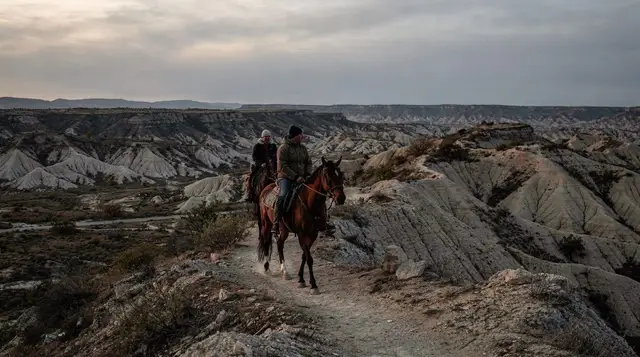
What does survive is a working link between the region and riding, even if it looks different from the ancient one. Stables operate around Göreme and Ürgüp, and valley rides through Rose Valley, Red Valley and Love Valley are a genuine, popular way to see the terrain, typically timed for sunrise or sunset when the light is best and the heat is lowest. Visitors interested in seeing the valleys from the saddle can currently book options such as a Cappadocia horseback ride timed for sunset or sunrise out of Göreme, or a sunset horseback tour through the valleys around Göreme.
Both are modern tourism products built for scenery rather than any breeding tradition, and neither should be confused with the ancient reputation this page has been describing; a separate practical guide on horse riding in Cappadocia covers booking details, fitness levels and what to expect in the saddle.
It is a fair, if inexact, continuity: a plateau once known widely enough for its horses that a Persian province took the name, still hosting working stables in the same valleys more than two thousand years later. The scale and the economics have changed completely. The rock, the plateau, and something of the reputation have not.
How to read the name when you visit
It helps to carry the uncertainty with you rather than the slogan. When a guide or a hotel host tells you that Cappadocia means “land of beautiful horses”, the honest response is that this is the leading explanation, backed by a long documented reputation, and not a certainty. That framing makes the rest of a trip richer, because the same careful habit applies to almost everything you will hear on the plateau: dates for rock-cut churches, stories about the underground cities, the origin of a valley’s nickname. Some of it is solid, some of it is tradition, and the best guides say which is which.
If the history is what drew you here, the Göreme Open-Air Museum and the wider cave churches and frescoes belong on the same trip, since they show what the plateau became after the Persian and Roman centuries. For the geology that shaped both the pasture and the valleys, the guide to the volcanoes that made Cappadocia is the natural companion to this page.
Seeing the plateau as a horse country
The most useful thing a visitor can do to appreciate the old reputation is to look beyond the famous valleys. A day that takes you out toward Sultanhani or across the open ground near Kayseri gives a different sense of the land: wide, open, and far more obviously suited to herds than the narrow canyons around Göreme. The same is true of the long road views on the way in from Ankara or Konya, where the steppe character of the plateau is easy to read from a car window.
A day with a guide can also give context that a map cannot. Guides who know the history will often point out how the high ground, the grass and the water fit together, and why settlements clustered where they did. A guided visit such as the guided tour of the open-air museum at Göreme is a reasonable way to hear the region’s layered history told by someone who knows it, which is a better use of an hour than reading a plaque.
From the saddle: what a valley ride adds
Riding does not prove anything about antiquity, but it changes how you read the land. From a horse you move at the pace that people moved through these valleys for most of their history, and the scale of the terrain becomes clear in a way that a minibus window does not allow. Paths that look like a thin line on a map turn out to follow the folds of the tuff, with long open stretches between the rock formations.
For a first ride, the practical advice lives elsewhere on the site. The guide to horse riding for beginners explains what to expect if you have never sat on a horse, and the general guide to horse riding in Cappadocia covers how rides are organised. If you want the classic evening version, the account of a sunset horse ride in Love Valley describes the route and the light, and Love Valley itself is worth a visit on foot too. Riders who want more than an hour or two can look at multi-day horse treks, which cover the plateau at a far more generous scale.
Choosing between ways of seeing the valleys is a real decision, and the comparison of valleys on foot, by quad or on horseback lays out the trade-offs honestly. Some travellers prefer the slower, quieter option of the saddle; others prefer to walk, or to cover more ground quickly. Whichever you pick, a ride at the edge of the day, when the light is low, is the version most visitors remember. If the idea appeals, a horseback ride at sunset or sunrise is the straightforward way to try it.
Other animals, other ways to travel
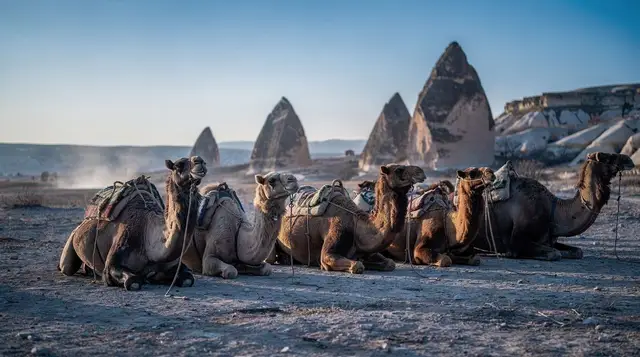
Horses are not the only animals that have carried people across this land. The caravanserais along the old trade routes, such as the one at Sultanhani, were built for camel trains, and the region still offers a taste of that world today. The guide to camel rides in Cappadocia explains what that experience is like, and an early start with a sunrise camel ride from Göreme is one way to try it. Travellers who would rather cover the rougher ground by engine can compare the jeep safari with the quad tours, both of which reach corners of the valleys that a short walk will not.
Where the horse story meets the rest of the trip
A trip built around this theme does not need a separate itinerary; it fits comfortably inside a normal one. A first visit might follow the three-day first-timer itinerary and slot a ride into the evening of the second day, while a slower trip, such as the five-day slow itinerary, leaves room for a longer ride without rushing the rest. Those who like the idea of the past made visible can pair the ride with a visit to Hattusa, the Hittite capital that appears earlier in this page, which is a longer excursion but one that connects directly to the oldest horse text mentioned above.
Light and weather affect any ride, so it is worth reading the guide to the best time to visit Cappadocia before you fix the date, and the advice on what to wear before you pack. Evening riders should also think about the walk back and the plan for dinner; the Göreme walking guide and the notes on where to eat in Göreme help with both.
What the name tells us, and what it does not
The pleasure of this particular piece of history is that it is modest. Nobody can show you the exact moment the name was coined, and nobody can show you a stable that is two thousand years old. What you can see is a plateau, a long chain of rulers who each kept the name, and a few working stables in the valleys. That is enough. A name that was good enough for a Persian province and survived Greece, Rome, Byzantium, the Seljuks and the Ottomans says something real about how the region was seen, even if the exact words behind it remain a matter of scholarly debate.
Horse riding experiences on GetYourGuide
Verified deep-linked GetYourGuide tours. Book through these links and we earn a small commission at no cost to you.
GetYourGuide does not provide a product photo for this activity — the image shows the meeting point, photographed by us.