Multi-day horse treks in Cappadocia
What is a multi-day horse trek in Cappadocia?
It is a route of several consecutive days in the saddle, linking valleys and sometimes villages beyond Göreme, run by specialist trekking outfitters rather than the standard one- or two-hour tourist rides. It is built for riders who are already comfortable and fit in the saddle, not a step up from a first-timer's sunset ride.
Not the same trip as a two-hour ride
Cappadocia is sold on horseback almost entirely through short outings: an hour or two around Love Valley at sunset, a sunrise loop before the balloons land, a photo stop at a viewpoint. Those rides are aimed at anyone, riders and non-riders alike, and our beginner’s guide to horse riding covers exactly that market. A multi-day trek is a different product built for a different rider.
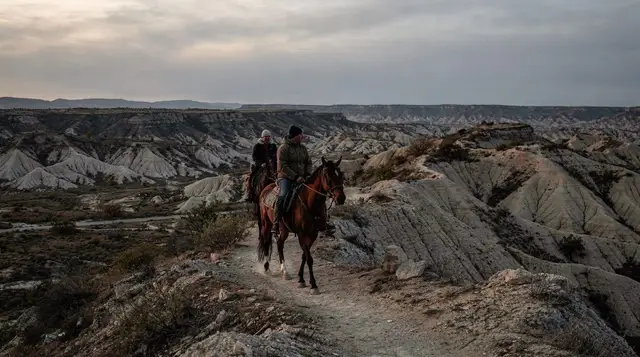
It links several valleys, sometimes crosses into terrain well beyond the tourist loop, and runs over two, three or more consecutive days rather than a single evening slot. If you have never sat on a horse before, this is not where to start — book a single ride first, see how your body handles it, and treat that as a separate decision rather than a warm-up lap for a trek.
The distinction matters because the two experiences are marketed inconsistently. A trekking outfitter’s website photo of cheminées de fées at golden hour looks identical whether it is promoting a ninety-minute loop or a four-day route, and it is easy to assume the longer version is simply “the same thing, more of it.” It isn’t. A multi-day trek asks more of the horse, more of the rider, and more of the planning behind the scenes, and none of that is visible in a photograph.
Who this actually suits
Multi-day trekking in Cappadocia is built for riders who already have hours of saddle time behind them: people who can post a trot without being told how, who know how to shorten and lengthen reins on the move, who can manage a horse that spooks at a dog or a motorbike without panicking, and who have sat for three or four hours in a saddle before, even if not on consecutive days. Outfitters running these trips generally ask about riding background before confirming a place, because a rider who struggles on day one slows the whole group and cannot simply be walked back to a minibus the way a day-tour client can.
It also suits people who want to see Cappadocia’s terrain from a genuinely different angle than the coach-and-viewpoint circuit. Multi-day routes can move through quieter ground — the fringes of valleys most day visitors only walk into for twenty minutes, farm tracks between villages, and stretches with no other tourists in sight. If that appeal is really about the landscape rather than the riding, it is worth honestly asking whether a multi-day hike would suit you better: see the best hikes in Cappadocia or a look at the region on foot versus in the saddle in valleys on foot, quad or horseback.
What a multi-day route typically links
There is no single fixed itinerary — routes are set by each outfitter and change with the season, water availability and which tracks are passable. In general terms, though, multi-day treks tend to string together valley riding close to Göreme with longer transfers toward quieter ground further out. A route might begin in the Rose Valley or Red Valley area, move through less-visited ground toward Soğanlı, and use villages as overnight anchors rather than as day-trip stops.
Reviewing the terrain guides for the areas an operator names in their itinerary is a sensible check before booking: Rose Valley, Red Valley at sunset, Love Valley and Soğanlı valley all describe the ground on foot, which gives a reasonable sense of gradient and surface even though you will be covering it on horseback.
Some operators also range toward the foothills of the Aladağlar, well outside the usual day-trip radius, where the terrain shifts from soft tuf to harder, more mountainous ground. That is a meaningfully different environment from valley riding around Göreme, with steeper trails and cooler air at altitude — see trekking the Aladağlar for the walking-trip version of that same country. Whichever route an outfitter proposes, ask for a day-by-day breakdown before booking rather than trusting a marketing paragraph: distance per day, terrain type, and where each night is spent.
Endurance: the horse’s and yours
A single ride puts you in the saddle for an hour or two at a controlled, guided pace. A multi-day trek asks for four to six hours of riding on most days, several days in a row, often with real elevation change and long stretches with little to no shade — the same conditions that make hiking here demanding in summer, described in hiking safety in the valleys. Soreness that a single ride never reveals shows up by the second consecutive day: inner thighs, lower back, hands from constant rein contact. Riders who have only ever done short outings are often surprised by how much cumulative time in the saddle changes the experience, even at a gentle pace.
The horse’s condition matters just as much. A trekking outfit’s horses need to be fit for repeated days of work, properly rested between legs, and matched to the terrain — a horse used mainly for short valley loops is not automatically suited to a four-day route with real distance and gradient. A responsible operator manages this by rotating horses, planning realistic daily distances, and building in rest. It is a fair question to ask directly: how are the horses conditioned for a multi-day route, and what happens if one of them is not fit enough to continue.
Heat compounds both problems. Cappadocia’s dry, exposed terrain offers very little shade even on foot; on a horse, moving more slowly through open ground over several consecutive afternoons in July or August is a genuine risk of heat exhaustion for horse and rider alike. This is one of the clearest reasons multi-day treks are better attempted in spring or autumn — see best time to visit Cappadocia — rather than at the height of summer.
Accommodation on the trail
This is where multi-day treks vary most between operators, and it is worth confirming in writing before you book rather than assuming. Cappadocia’s signature stay is the cave hotel — a room genuinely cut into the rock, cool and dim, described in full in our guide to where to stay in Cappadocia — but a multi-day trek does not automatically include one.
Overnight stops on a trekking route are set by logistics: where the horses can be stabled or paddocked safely, where there is water, and how far the next day’s leg needs to start from. That can mean a simple village guesthouse, a farmhouse attached to the stable running the trek, or occasionally a night back in Göreme or a nearby town in a standard hotel. Some higher-end multi-day packages do build in a cave-hotel night as part of the itinerary, but it is the exception rather than the rule, not the default.
| What varies night to night | Typical range |
|---|---|
| Accommodation type | village guesthouse, stable farmhouse, standard hotel, occasionally a cave hotel |
| Meals included | varies by operator — confirm which meals are covered and which are not |
| Distance covered per day | roughly 15–30 km in the saddle, depending on terrain and route |
| Horse changed or rested | some operators rotate horses on longer routes, others do not |
| Group size | usually small, often four to eight riders per trek |
Because standards differ so widely, ask specifically what “accommodation included” means for each night of a proposed itinerary, not just for the trip as a whole.
A day-ride versus a multi-day trek, side by side
| Single day ride | Multi-day trek | |
|---|---|---|
| Duration | 1–2 hours | 2+ consecutive days |
| Rider experience needed | none to minimal | comfortable, competent rider |
| Route | fixed loop, guided throughout | varies by day, may leave the tourist circuit |
| Accommodation | not applicable | depends on operator — not always cave hotels |
| Booking channel | widely available through tour agencies and online platforms | specialist equestrian outfitters, booked directly |
| Physical demand | low | cumulative — rises sharply from day two |
If you are unsure which category suits you, a single ride is the honest way to find out — not a discount preview of a longer trip, but a genuine test of how your body handles a few hours in the saddle on this terrain. A sunset loop through Love Valley is one option:
a sunset horseback tour through Göreme’s valleys and a sunrise ride before the heat builds is another:
a sunrise or sunset horseback ride around CappadociaNeither commits you to anything beyond that morning or evening, and both give a far more honest read on your comfort level than assuming a two-hour ride will simply feel proportionally smaller than a multi-day trek.
Choosing an operator
Because multi-day treks sit outside the standard Göreme tour-agency system, vetting an operator takes more legwork than picking a day tour off a shelf. Look for outfitters who keep their own horses year-round rather than hiring animals in for the season, who can describe the specific route day by day, and who are upfront about accommodation, meals, group size and what happens if weather or a horse’s condition forces a change of plan.
Ask how experienced the guides are with the specific terrain proposed, particularly if the route strays toward the Aladağlar or other ground beyond the usual valley network. A reluctance to give specifics — vague answers about “amazing scenery” rather than concrete distances and stops — is a reasonable reason to keep looking.
It is also worth asking directly about horse welfare on longer routes: how animals are rested, whether the same horse is ridden every day or rotated, and what training or conditioning goes into preparing them for multi-day work rather than short valley loops.
What to pack
Beyond the standard Cappadocia packing list — covered fully in packing for Cappadocia — a multi-day trek adds a few specifics. Proper riding trousers or well-fitted long trousers reduce chafing over consecutive days far more than typical travel clothing. A hat that stays on at a trot, sun protection reapplied through the day, and a hydration system you can access without dismounting all matter more here than on a single short ride.
Broken-in boots with a small heel are worth bringing rather than relying on hire equipment, and a change of clothes for evenings that does not depend on laundry mid-trek. Confirm with the operator what riding gear — helmet, chaps, saddle type — is provided and what you are expected to bring yourself.
Cost
Multi-day treks are priced in Turkish lira and vary by operator, route length, group size and what is included, so treat any figure as a rough range rather than a fixed rate. A package typically covers horse hire, a guide, accommodation and some or all meals; it is priced per day of the trek rather than as a multiple of a single ride’s price, and the daily rate is usually noticeably higher than a single outing once accommodation and logistics are folded in. Get a full breakdown of what is and is not included — meals, transfers to and from the starting point, and any single-supplement charge if you are travelling alone — before comparing quotes between operators.
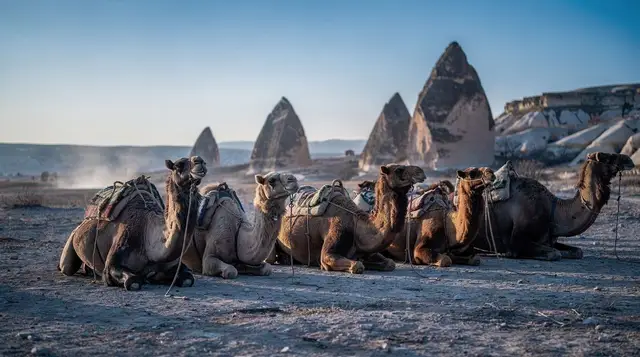
If a multi-day trek turns out not to suit your schedule or budget, Cappadocia’s terrain still rewards a day of saddle time. A sunrise camel ride is a genuinely different animal and pace worth comparing:
a sunrise camel riding excursion near Göreme and for covering similar ground mechanically rather than on an animal, a jeep safari reaches valleys and viewpoints that horse routes also pass through:
a Cappadocia jeep safari through the valleysNeither replaces the specific experience of a multi-day trek, but both are useful ways to see the same landscape without committing several consecutive days to the saddle.
A last word of caution
It is tempting to treat a multi-day trek as the natural next step after enjoying a single ride — book the sunset loop, love it, and sign up for four days the following year. Resist that logic. A short guided ride tells you almost nothing about how your body handles four to six hours a day for several consecutive days, how you cope with a horse that is tired rather than fresh, or how you manage in terrain with no vehicle nearby if something goes wrong.
Build up saddle time deliberately — several shorter rides over time, ideally including at least one longer outing of three or four hours — before committing to a multi-day route, and be honest with the operator about your actual experience rather than what you would like it to be. A trekking outfit that takes riding history seriously and asks pointed questions before confirming your place is, if anything, a good sign rather than an obstacle.
Horse riding experiences on GetYourGuide
Verified deep-linked GetYourGuide tours. Book through these links and we earn a small commission at no cost to you.
GetYourGuide does not provide a product photo for this activity — the image shows the meeting point, photographed by us.