Where to eat in Göreme
Where should I eat in Göreme?
Göreme's centre is dense with restaurants built around heavy tourist traffic, so choice is rarely the problem — consistency of quality and price is. A number of places open unusually early to catch groups arriving straight off a sunrise balloon flight. For a slower, more local pace, many visitors do at least one meal in nearby Ürgüp, which sees less through-traffic.
What shapes the food scene in Göreme
Göreme is a village, not a city, and its restaurant scene reflects that directly. A small core of streets around the otogar and the main square carries almost all of the eating options, and nearly every one of them depends on visitor traffic rather than a resident population, which is small. That isn’t a criticism — it’s the honest starting point for choosing where to eat here. Menus are printed in English as often as Turkish, portions and pricing are pitched at an international audience, and staff in most places are used to explaining dishes to people who have never seen a testi kebab arrive at the table in a sealed clay pot.
That doesn’t mean the food is generic. Cooks in Göreme are still working from the same regional repertoire as anywhere else in Cappadocia — manti, gözleme, pide, kuru fasulye, sac tava — and a genuine local scene sits underneath the visitor-facing surface, particularly for breakfast and for anyone willing to walk a street or two back from the main square. The concentration of restaurants is high enough that competition on quality is real; it just takes a bit of judgement to find it, because volume of choice and consistency of quality don’t automatically move together in a village this dependent on tourism.
Göreme’s food scene versus Ürgüp
It’s worth being specific about how Göreme differs from Ürgüp, because the two towns get lumped together constantly in trip planning and they don’t offer the same evening. Göreme sits at the centre of the region’s cave-hotel cluster and its balloon launch logistics, so it carries far more passing traffic: tour groups between activities, guests checking in and out of troglodyte rooms in the centre of the village rather than on its edges, and a constant churn of day visitors arriving from Nevşehir or Kayseri. Restaurants respond to that rhythm — fast turnover, multilingual staff, a menu built to be understood at a glance.
Ürgüp, roughly fifteen minutes away, has its own hotels and its own visitor economy, but the centre feels less saturated. There’s more distance between the tourist core and daily village life, and evenings there tend to feel calmer rather than busier. Neither pattern is better outright — a first-time visitor often wants Göreme’s convenience and buzz, while someone staying a second or third time in the region gravitates toward Ürgüp for a change of pace. A separate guide covers where to eat in Ürgüp in its own terms rather than as a comparison, and it’s worth reading if your base or your itinerary includes both villages.
Early hours, and the balloon connection
One quirk of Göreme’s restaurant timetable is directly tied to hot air ballooning. Flights leave at first light, hotel pickup runs roughly an hour to an hour and a half before that, and a flight itself lasts anywhere from 45 minutes to an hour and a half depending on the package. That means groups are commonly back in the village well before eight in the morning, hungry, and still running on adrenaline from the flight. A cluster of cafés and breakfast spots near the main square and the balloon operators’ meeting points has built its opening hours around exactly that window, serving full breakfast well ahead of when a village this size would normally expect custom.
If you’ve booked a flight, or you’re deciding on the timing detailed in the Cappadocia hot air balloon guide, it’s worth knowing this in advance rather than discovering it on the morning itself: some restaurants will be open and busy at an hour when most of the village is still quiet, and others simply won’t have opened yet. The exact rhythm shifts a little by season, since sunrise timing changes across the year and pushes launch — and therefore breakfast — earlier in summer and later in winter.
What’s actually on the menu
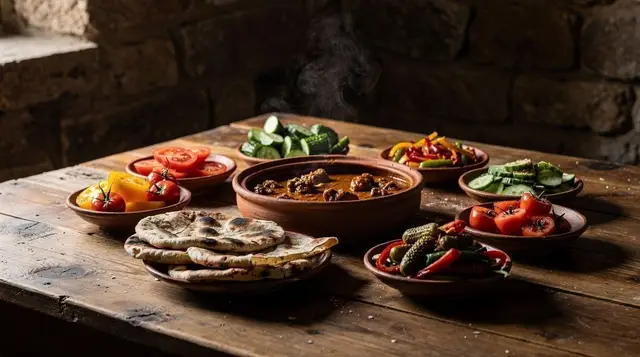
Cappadocian cooking draws on the wider Central Anatolian table, and Göreme’s restaurants generally cover the same core dishes you’ll find across the region, adapted more or less to visitor expectations depending on where you sit down. Testi kebab — meat and vegetables slow-cooked in a sealed clay pot, cracked open at the table, sometimes theatrically — has become something close to a regional signature dish and appears on the great majority of menus aimed at visitors.
Manti, Turkey’s small dumplings served under yoghurt and a chilli-butter sauce, gözleme (a thin savoury pancake, often folded and grilled to order), pide (Turkey’s answer to a long, boat-shaped flatbread pizza), kuru fasulye (a white bean stew) and sac tava (a pan-fried meat and vegetable dish) round out what you’ll see repeated across menus.
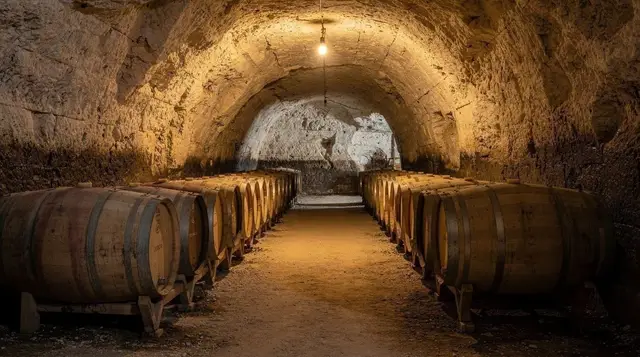
Drinks follow their own pattern. Çay — Turkish tea, poured strong from a two-tier kettle into small tulip glasses — is everywhere and effectively the default. Turkish coffee, thick and unfiltered, sits alongside it. Cappadocia is also genuinely old wine country, and it’s worth treating that seriously rather than as a footnote: look for Emir, a light regional white grape, alongside Kalecik Karası, Öküzgözü and Boğazkere among the reds, many produced from vineyards you’ll have driven past without necessarily noticing them.
Restaurants around Göreme and neighbouring Ürgüp increasingly put a regional bottle on the list rather than a generic import, and the fuller Cappadocia wine guide and the guide to Ürgüp’s wine cellars go into where that comes from if you want to follow it further. For the food side in more depth, the Cappadocian food guide and a dedicated page on testi kebab both go beyond what fits here.
General criteria for choosing where to eat
Rather than pointing at specific addresses — which date quickly and vary in quality from one season to the next — it’s more useful to know what to look for on the ground in Göreme. A few general, durable criteria:
- Look at who’s eating there. A room with a mix of Turkish customers and visitors, not exclusively tour groups, is usually a more reliable signal than décor or a busy tout outside the door.
- Check that prices are visible before you sit down. A printed or posted menu with prices, in whatever language, is standard practice; an absence of visible pricing is worth noticing.
- Be wary of being steered off the street. Göreme’s centre has its share of touts working for a commission, and a friendly recommendation delivered mid-walk is not the same thing as independent advice — see the wider guide to safety and scams in Cappadocia for how this fits into the bigger picture.
- Match the place to the meal. A spot built for a quick breakfast before a balloon flight is not necessarily the right choice for a slow dinner, and vice versa; Göreme has enough range that it’s worth choosing deliberately rather than defaulting to whatever is closest to your hotel.
- Treat viewpoint cafés as a separate category. They’re set up for a drink and a view rather than a full meal — the guide to Göreme’s viewpoint cafés covers that use case on its own terms, and conflating the two leads to disappointment either way.
This page is deliberately staying at that level rather than naming individual restaurants: turnover, ownership and quality shift too fast in a village this size for a specific recommendation to stay accurate for long, and a general set of criteria travels better across seasons than a list of names.
Breakfast, lunch and dinner in practice
Breakfast in Göreme runs on two overlapping schedules. There’s the early-morning rush tied to balloon flights described above, and there’s the more conventional Turkish breakfast — spread across small dishes of cheese, olives, tomato, cucumber, honey, jam and bread — that most cave hotels serve as part of the room rate from a more normal mid-morning hour. The Turkish breakfast in Cappadocia guide covers what to expect from that spread in more detail.
Lunch in the village tends to be lighter and faster, aimed at people breaking between a morning in the valleys and an afternoon activity, or stopping between stages of a Red or Green Tour. Dinner is where Göreme’s restaurants put in the most effort: this is when testi kebab is at its most visible, when wine lists get used, and when restaurants with any kind of terrace or rooftop lean into the setting.
Given how compact the centre is, walking between a few options before committing is realistic and common — the Göreme walking guide is useful for orienting yourself around the village’s layout if you haven’t already. For what the village looks like once the kitchens are done for the night, Göreme after dark covers the evening scene beyond just eating.
Where restaurants fit around a wider stay
Food is only one piece of deciding how to spend evenings in the village, and it connects to a couple of other practical questions worth having settled before you arrive: how many nights to plan around (how many days in Cappadocia), and where to actually sleep, since Göreme’s dense hotel cluster is part of what fills its restaurants in the first place — see where to stay in Cappadocia and cave hotels explained for that side of the planning.
Some visitors also build a food-focused activity into the trip rather than treating meals as a purely functional stop between valleys. A hands-on cooking class in Kings Valley is a way to get past a menu and actually work with the same dishes described above — manti, gözleme and the rest — with someone explaining technique rather than just serving the result.
For something shorter and drink-focused, a Turkish coffee workshop using the traditional sand-cooking method is a compact way to get past the coffee shown on a café menu and understand how it’s actually made. And for one specific meal built around setting rather than range of dishes, a breakfast experience out in Göreme Valley replaces the usual hotel spread with a table set outdoors among the rock formations — worth knowing about if you want one meal during the stay to be about the view as much as the food.
Practical notes
A few things worth carrying into any meal decision in Göreme. Cards work reliably at established restaurants in the centre, but it’s still sensible to keep cash on hand, since the currency remains volatile and not every smaller place or workshop has a reliable card reader. Tap water isn’t recommended for drinking anywhere in the region, Göreme included, but bottled water is cheap and served automatically almost everywhere, so it rarely becomes an issue at the table. And because the village’s whole rhythm bends around the balloon schedule, checking sunrise time for your dates before booking a table — whether that’s an early breakfast or a normal dinner slot — avoids arriving to find a kitchen not yet open, or already quiet for the night.
Finally, it’s worth remembering that Göreme is a base for exploring the wider region as much as it is a destination for a big night out. Many restaurant-goers here are eating an early or efficient meal precisely because the next morning starts at the Göreme Open-Air Museum or out in one of the surrounding valleys before the heat and the crowds arrive. Planning food around that rhythm, rather than against it, tends to produce a better run of meals than chasing a single standout restaurant.
Questions about eating in Göreme
What time do restaurants in Göreme open?
Ordinary opening hours run from mid-morning, but a cluster of cafés and breakfast places near the main square and the balloon meeting points open well before 7am specifically to catch groups back from a sunrise flight. Standard lunch and dinner hours elsewhere follow the pattern you’d expect in the wider region.
Is Göreme good for vegetarians?
Broadly yes. Bean, lentil and vegetable-based dishes such as kuru fasulye, along with bread-based options like gözleme and pide, are easy to find without meat, but it’s worth confirming ingredients directly rather than assuming, since stocks and sauces aren’t always vegetarian by default.
Should I eat wherever my tour guide or hotel recommends?
Treat it as one opinion rather than a verdict. Commission arrangements between drivers or guides and specific restaurants exist in Göreme, as in most tourist towns, so it’s worth cross-checking against who’s actually eating there and whether prices are shown up front.
Can I pay by card in Göreme restaurants?
Most established restaurants in the centre take cards without trouble. It’s still sensible to carry some Turkish lira in cash for smaller places, workshops and market stalls, where card readers are less consistent.
Is Göreme or Ürgüp better for eating out?
They suit different moods rather than one being objectively better. Göreme has more volume and more tour-group traffic; Ürgüp is quieter and less built around passing footfall. Many visitors base themselves in one and still make a separate trip for a meal in the other.
Are the viewpoint cafés in Göreme good for a full meal?
Not really — they’re set up for a drink with a view rather than a sit-down meal. The guide to Göreme’s viewpoint cafés covers that separate use case in full.
Is tap water safe to drink with meals in Göreme?
No, tap water isn’t recommended for drinking anywhere in Cappadocia, Göreme included. Bottled water is inexpensive and served as standard almost everywhere, so it’s rarely a practical problem at the table.
Cappadocia food & drink tours on GetYourGuide
Verified deep-linked GetYourGuide tours. Book through these links and we earn a small commission at no cost to you.
GetYourGuide does not provide a product photo for this activity — the image shows the meeting point, photographed by us.