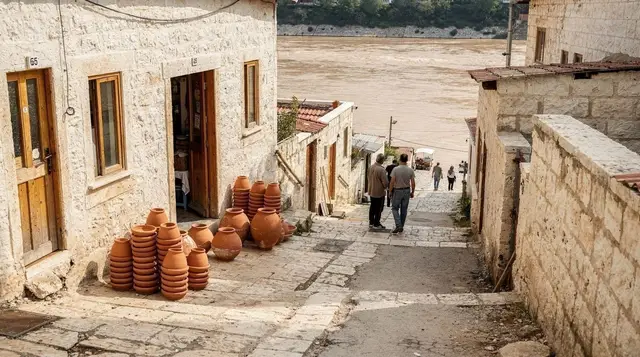
Most people who reach Gülşehir are passing through on the way to somewhere else — Avanos, the salt lake, or the road north out of the region. Açık Saray sits just outside town, close enough to be a short stop rather than a destination in its own right, and it’s easy to miss entirely if nobody tells you it’s there. That’s more or less the appeal.
A rock-cut settlement without the crowds
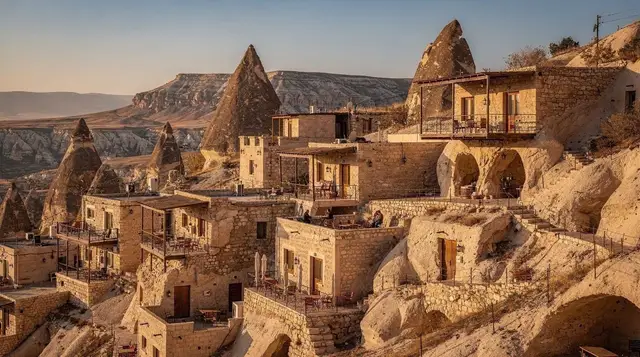
Açık Saray, which translates as “open palace,” is a cluster of dwellings and other structures carved into cone-shaped and ridged tuff formations on the edge of Gülşehir. The rock here is the same volcanic tuff that shapes fairy chimneys across the wider region — soft enough to be hollowed out by hand, hardened over centuries by exposure, and eroded by wind and rain into the pale, layered cones you see approaching the site.
The name is popular usage rather than a settled historical verdict on what the site was for. What’s confirmed, and what you can actually see, is a group of rock-cut structures: rooms, openings and passages carved into the formations, spread across a compact area rather than concentrated behind a single entrance the way the Göreme open-air museum is. There’s no interpretive signage walking you through room by room, no marked route, and no attendant explaining what you’re looking at. You wander, you look up into openings that were once doorways, and you form your own impression.
That absence of framing is the main thing that separates Açık Saray from the region’s headline sites. At Göreme’s museum, the Karanlık Kilise and the other churches are curated: ticketed, lit where it matters, roped where it needs to be, and busy with other visitors between roughly 10am and 3pm. At Açık Saray, on most days, you might see nobody else at all.
What it’s actually like on the ground
Açık Saray is smaller and less dense than it can sound from a distance. It isn’t a canyon walk like the Ihlara valley or a multi-hour loop; it’s a contained cluster of formations you can circle and climb around in under an hour. The tuff cones here are honeycombed with openings at different heights, some reachable on foot, others visibly requiring a scramble that isn’t advisable without knowing the rock’s condition.
Because there’s no ticket booth reliably staffed and no path maintenance, the ground is uneven gravel and eroded tuff rather than a laid trail. Closed shoes matter more here than at managed sites, and there’s very little shade — the same practical caution that applies across the region’s rock-cut sites applies here, just without a gift shop or a café at the end of it to retreat to.
What you notice most is the quiet. No queue, no ticket line, no guide with a raised umbrella leading a group of twenty. If you’ve already done the open-air museum or walked through Zelve and found both worthwhile but crowded, Açık Saray gives you the same basic material — rock-cut rooms, the physical fact of people once living inside a volcanic cone — with none of the choreography around it.
Açık Saray versus Göreme’s open-air museum
It’s worth being direct about the trade-off, because the two sites answer different questions.
| Açık Saray | Göreme open-air museum | |
|---|---|---|
| Ticketed entrance | Rarely staffed, don’t rely on it | Yes, plus a separate ticket for the Karanlık Kilise |
| Frescoes and painted churches | Not the draw here | The main reason to go |
| Crowds | Usually near-empty | Busy 10am-3pm most of the year |
| Signage and route | None | Marked route, information panels |
| Facilities | None on site | Ticket office, toilets, parking |
| Time needed | 45-60 minutes | 1.5-2 hours |
If you only have one visit in you for rock-cut Cappadocia, the open-air museum is still the better use of it — the frescoes and the concentration of churches aren’t matched here. Açık Saray is a second-visit site: for people who’ve already covered that ground and want to see the same volcanic architecture without the ticket line.
Getting there from Göreme
Açık Saray sits close to Gülşehir, on the north-western edge of the core Cappadocia area, roughly 30-35 minutes by car from Göreme along the road that also passes Nevşehir. There’s no dolmuş service to the formations themselves — minibuses run between the main villages and into Gülşehir town, but the last stretch out to the site is not covered by scheduled public transport.
In practice that leaves three realistic ways to get there:
- Self-drive, which gives you full control over how long you stay and lets you combine the stop with Gülşehir and the nearby St John’s church without waiting on anyone else’s schedule. See our notes on car rental and driving conditions in the region before booking.
- Taxi, agreed and priced before you set off, with either a wait-and-return arrangement or a pickup time fixed in advance.
- A private full-day tour with pickup, where you set the itinerary rather than following a fixed circuit. This is the only way to see Açık Saray if you don’t want to drive yourself, since none of the standard colour-coded tours (Red, Green, Blue) include it as a stop.
a private full-day tour with pickup that you can route through Gülşehir and Açık Saray is the straightforward option if self-driving isn’t for you — you tell the driver where you want to stop rather than following someone else’s fixed loop.
If you do have your own transport for other reasons — for example if you’ve booked a self-drive balloon-region explorer pass that already has you behind the wheel — Açık Saray is an easy add-on rather than a special trip.
What’s near it: Gülşehir and St John’s church
Açık Saray rarely justifies a dedicated round trip from Göreme on its own; it earns its place as part of a loop through Gülşehir. The town itself has its own rock-cut church of St John, and the pairing of the two — a short walk around the church, then out to the tuff formations on the edge of town — makes for a sensible half-day without much backtracking. Our combined guide to Açık Saray and St John’s church in Gülşehir covers that pairing in more detail.
If you’re routing further afield the same day, Avanos with its pottery workshops on the Kızılırmak river sits close by, and it’s a reasonable third stop if you’ve started early.
No facilities, and what that means for planning
This is the point worth repeating rather than glossing over: there is no visitor infrastructure at Açık Saray. No consistently staffed ticket office, no toilets, no shop, no shaded seating area, no water for sale on site. Bring your own water, use facilities in Gülşehir or Göreme before you set out, and don’t expect a ticket receipt or an official map handed to you at an entrance gate.
Mobile signal in the immediate area of the rock formations can be patchy, so it’s worth having your route to and from the site saved offline or noted down rather than relying on a live connection once you’re there.
None of this makes the site difficult to visit — it’s a short, self-contained stop, not a wilderness trek — but it does mean treating it differently from a paid attraction with fixed opening hours. Go in daylight, don’t plan on anything being open or staffed, and budget your visit as flexible rather than scheduled.
When to go
The same seasonal logic that applies across Cappadocia applies here. April to June and September to October give you comfortable daytime temperatures without the peak-summer heat that makes an unshaded rock site uncomfortable by midday. Since there’s no shelter here at all, midsummer visits are better done in the morning, before temperatures climb into the 30s.
Winter is quieter still, and the pale tuff formations photograph well against a grey sky, but check road conditions if there’s been recent snow — this is a minor road rather than a main route, and clearing isn’t always a priority.
How much time to set aside
Forty-five minutes to an hour covers the site itself for most visitors. Add in the drive from Göreme, a stop in Gülşehir and a look at St John’s church, and you’re looking at roughly half a day round trip rather than a quick detour. It doesn’t need to anchor a full day on its own — pairing it with the salt lake and an underground city further south, for instance on a combined salt lake and underground city tour with lunch, would be a different, longer day rather than the same trip.
Where it fits in a Cappadocia itinerary
Açık Saray isn’t a first-visit priority. If this is your only trip to the region, the open-air museum, the underground cities and one of the standard colour tours will cover more ground, more efficiently, with better-preserved carving to show for it. Something closer to the Red/North tour that covers the museum, Paşabağ and Zelve is the better use of a single day if you haven’t seen those yet.
Where Açık Saray earns its place is on a second visit, a longer stay, or for anyone who has done the main circuit and specifically wants somewhere quieter to compare it against. If you’re building your own route rather than following a set tour, our guide to seeing Cappadocia without a tour has more on stitching together stops like this one, and our viewpoints guide covers a few other under-visited spots in the same spirit.
How to look at a site with no signs
Without panels to read, it helps to bring a method. Start by walking once around the outside of the formations before going near any opening. From a distance you can see how the cones sit in relation to each other, which openings share a level, and where the rock has collapsed or weathered back. Then pick one cone and look at it slowly: the shape of a doorway, the way a wall has been squared off, the shallow niches and ledges that suggest where people stored things or slept. Small details like these are what the site offers in place of a guided explanation.
It also helps to remember what you are looking at. This is the same soft volcanic rock described in the volcanoes that made Cappadocia, and the same logic of digging inward rather than building outward that you will meet in the cave churches and frescoes and in how the underground cities worked. Açık Saray shows that logic at the scale of an ordinary settlement, without the decoration that draws crowds elsewhere.
Photography and light
The pale tuff is at its best in low, side-on light, when every ridge and opening throws a shadow and the cones look sculpted rather than flat. Early morning is the natural choice, and it also happens to be the cooler and quieter part of the day. Around midday, with the sun overhead and very little shade, the formations flatten out and the glare off the pale rock is tiring on the eyes.
Because there are rarely other visitors, you can frame a doorway or a ridge without waiting for people to leave the shot. Keep a sense of scale in mind: a person standing near an opening, if you have a companion, shows how large the carved rooms really are. For more ideas on where to point a camera elsewhere in the region, the viewpoints guide and the balloon photography spots article cover very different, more famous scenes, and are a useful contrast to the stillness here.
Staying safe on loose rock
The tuff is forgiving to carve but not always forgiving to stand on. Edges can crumble, and the floors of some openings are worn smooth or covered in loose grit. Treat any opening that you cannot reach comfortably on foot as off limits, and keep children close. The general advice in hiking safety in the valleys applies just as well to a short stop like this one: tell someone where you are going, carry water, and turn back if the footing feels doubtful.
If anyone in your group is unsteady on rough ground, the guide for travellers with limited mobility and the guide for families with children suggest easier alternatives that still give a feel for the region’s rock-cut architecture.
Building a quieter day around it
Açık Saray works best as the calm part of a day that includes something livelier. A morning here, followed by a slow lunch in Avanos or back in Göreme, gives a good balance. The Avanos walking guide and the guide to pottery workshops in Avanos help you fill the afternoon, and where to eat in Göreme is useful if you are heading back to base in the evening.
If you like this kind of low-key stop, there are others in the same spirit. The Mazı and Gaziemir article describes places that most tours skip, the valleys nobody walks looks at the quieter side of the region’s hiking, and the guide to the quiet underground cities does the same for the subterranean sites. Cappadocia in one day and the two-day and three-day itineraries show where a stop like this might fit if you have more time, and slow five-day itinerary leaves room for exactly this sort of unhurried visit.
A note on expectations
Visitors sometimes arrive expecting a palace, because of the name, and leave puzzled. It helps to drop that expectation at the door. The name is a label, not a description of grand halls, and the pleasure of the place is in its plain, lived-in scale and its quiet. If you come for that, it tends to be a satisfying short stop. If you come for frescoes or a structured visit, the Göreme open-air museum guide and the Zelve open-air museum guide are the better places to start.
Açık Saray in a sentence
A small, unticketed, unstaffed cluster of rock-cut dwellings on the edge of Gülşehir — worth a short stop if you’re already passing, or if you’ve seen the main sites and want something with nobody else around, but not a reason on its own to change your route.