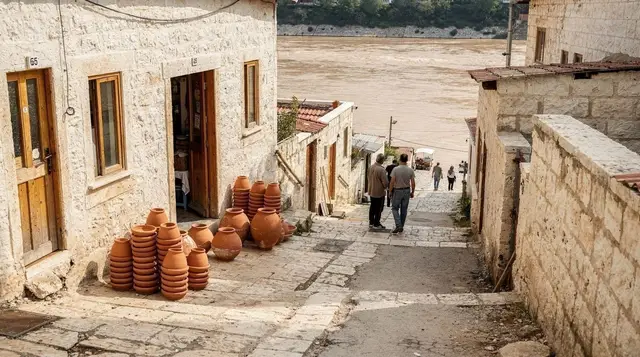
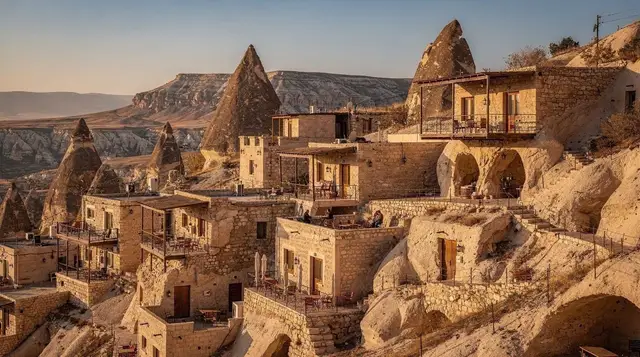
Wine cut into rock, not poured at a bar
Ürgüp sits on the same volcanic plateau as the rest of Cappadocia, and the same tuf that was hollowed into churches and dovecotes elsewhere in the region was, in Ürgüp, also hollowed into cellars. That’s the whole point of this page: not the town of Ürgüp, which has its own guide, and not a restaurant list, which the region’s food guide covers, but the cellars themselves — what the rock does for wine, why this particular stretch of plateau grows vines at all, and what a visit actually involves.
Tuf is soft enough to carve with hand tools yet stable enough to hold a room’s shape for centuries, and it keeps a near-constant temperature underground regardless of what the thermometer says outside. In July, when Ürgüp’s streets can push past 30 degrees in the afternoon, a cellar a few metres down stays markedly cooler. In January, when the plateau drops toward freezing, the same room stays markedly warmer. For fermenting and ageing wine, that stability is worth more than any purpose-built modern cellar would need to fake with insulation — the rock does it for free, and has done for a very long time.
The volcanic soil above ground matters just as much as the rock below it. The plateau sits at roughly 1,000 metres, and the ash and pumice deposited by the region’s old volcanoes broke down into a soil that’s mineral-rich, well-draining and low in the organic bulk that makes vines grow leaves instead of concentrated fruit. Add the altitude, which gives warm days and cool nights through the growing season, and you get conditions that winemakers describe as naturally suited to producing wine grapes with good acidity — the kind of terrain that would draw attention in most wine-producing countries, even without a single tasting room attached to it.
Why this is older than tourism
Grape growing on this plateau predates any modern wine industry by a long way. Cappadocia’s dry climate and volcanic soil favoured vines well before wine became something international visitors sought out here, and the rock-cut cellar was simply the local answer to a practical problem: how do you keep wine at a steady temperature in a region with no refrigeration and swings between summer heat and winter cold? Carving a room into tuf solved it, and once the technique existed for storage, it applied just as well to fermentation.
That history is worth knowing before you go, because it changes what you’re looking at. A cellar carved into rock a century or more ago is not a themed attraction built to look old — it’s a working space repurposed, extended or maintained across generations, doing the same physical job it always did. The stone walls, low doorways and irregular ceiling heights are functional, not decorative.
The same logic explains why so much of the region’s architecture looks the way it does. If you have walked through the Göreme Open-Air Museum or read about cave churches and frescoes, you have already seen what soft volcanic rock allows. The story of the volcanoes that made Cappadocia is the background to all of it, and the cellar is simply the most practical use of that rock: a room that keeps a steady temperature without anyone having to do anything. For the wider picture of regional bottles, grape growing and what to look for on a label, the Cappadocia wine guide goes further than this page, and the Ürgüp wine cellars guide covers the practical side of choosing a visit.
What separates a cellar from a night out
It’s easy to fold this into a general evening out in Ürgüp — dinner somewhere, wine with the meal, done. That’s a fine evening, but it isn’t a wine cellar visit, and treating the two as the same thing means missing the actual activity.
A cellar visit is built around the underground space itself: walking into the rock-cut rooms where fermentation and ageing happen, seeing the barrels or tanks in place, and understanding the mechanics of how volcanic stone keeps wine at a workable temperature without electricity. A tasting usually follows, but it’s the second half of the visit, not the whole of it. A restaurant meal with a glass of local wine, by contrast, tells you very little about how or where that wine was actually made — you’re eating in a dining room, not standing in the rock.
The distinction matters for planning too. A cellar visit runs to a couple of hours and fits into an afternoon alongside a walk around Ürgüp or Ortahisar. A restaurant dinner is an evening commitment on its own. Confusing the two leads to one of two disappointments: showing up at a restaurant expecting a geology lesson, or booking what you think is a relaxed dinner and finding it’s actually a structured cellar tour with a set timetable.
If the evening is what you are after, it is a different plan and a good one: where to eat in Ürgüp lists the options, and for something more staged there is the kind of evening described in the turkish tea and coffee culture and food pages, such as a candlelit dinner set up in the valley, which pairs naturally with a cellar visit earlier the same afternoon.
How a cellar visit usually unfolds
Most visits follow the same rhythm. You arrive, someone shows you down into the rock, and you walk through the rooms while they explain what happens where. The cool air hits first, then the smell of stone, barrels and fermenting fruit. After the walk-through you sit down, usually somewhere still inside or just outside the cellar, and taste what the place produces. Nothing about it is rushed, and it rewards a slow pace: the point is to look at the rock, ask how the wine is made and listen to the answer.
It helps to arrive curious rather than expert. Guides and cellar owners tend to enjoy questions about the rock, the old methods and the way the seasons change the work, and those questions get you further than trying to sound knowledgeable about grape varieties. If you do want to learn the vocabulary first, the Cappadocia wine guide is the place to start, and it is worth pairing the tasting with some of the local dishes described in the Cappadocian food guide so that you know what the wines are meant to sit alongside.
What to expect physically
Because these are working or formerly working cellars and not attractions built for accessibility, expect stone steps that aren’t perfectly even, doorways low enough to duck through in places, and uneven floors. Lighting varies — some cellars are well lit for visitors, others keep the dim, cool character that low light itself helps preserve. Bring closed shoes rather than sandals; the stone floors can be uneven and, near any wash-down areas, slightly damp.
Cellar temperature sits noticeably below the outdoor temperature in summer and noticeably above it in winter, which is worth knowing if you’re moving between a hot afternoon outside and a cool room below ground — a light layer helps in July, and the same room won’t feel cold in January the way the street does.
Sol volcanique et altitude, en clair
The short version of the geology, since it’s the reason any of this exists: the plateau’s tuf and volcanic ash soils drain well and hold minerals rather than heavy organic matter, which suits vines better than it suits most food crops. Altitude around 1,000 metres adds a wide swing between daytime warmth and night-time cool through the growing season, which is generally favourable for grapes grown for wine rather than table eating. None of that requires naming a specific grape variety to be true — it’s a statement about the ground and the climate, not a tasting note, and it’s the reason winemaking took hold on this particular stretch of plateau rather than being planted here by chance.
Planning a visit
| What | Detail |
|---|---|
| Where | Ürgüp, with cellars also found around Ortahisar and Mustafapaşa |
| Typical visit length | 1-2 hours for a cellar walk-through and tasting |
| Best paired with | A walk around Ürgüp or a stop in Ortahisar the same day |
| Rough budget | €25-70 per person depending on what’s included |
| Footwear | Closed shoes — stone steps and uneven floors throughout |
| Best months | April-June and September-October for comfortable travel between outdoor heat and cellar cool |
This page deliberately doesn’t name specific cellars, wineries or restaurants — that list changes, and a page built around named establishments goes out of date the moment one closes or changes hands. Ask locally in Ürgüp, check current listings, or ask your accommodation for a recommendation that matches what you want: a quick tasting, a longer cellar tour, or a full dinner with wine alongside it.
Fitting a cellar into a wider day
A cellar visit works best as the quiet part of a busy day. A morning spent on a valley walk, such as Rose Valley, Red Valley or the Love Valley walk, leaves you pleasantly tired, and the cool of a cellar in the afternoon is a welcome change. If you would rather start gently, an early balloon breakfast with the flights overhead, for example a breakfast at a private table while the balloons rise, leaves the rest of the day open for the town.
Around Ürgüp itself, the Ürgüp walking guide maps out the old quarter and viewpoints, and the destination page for Ürgüp gives the overview. Nearby, Mustafapaşa and Ortahisar make good companions, and the Mustafapaşa and Sinasos guide shows how the old Greek quarter fits with a slow afternoon. If you are still deciding where to base yourself, Göreme versus Ürgüp explains the trade-offs, and the three-day Cappadocia itinerary shows where a half-day like this can slot in without squeezing anything else out.
Getting there from Göreme
Ürgüp is about 15 minutes from Göreme by road, and dolmuş minibuses run between the two through the day, though services thin out in the evening. If you’re planning a cellar visit followed by dinner, either arrange a taxi back or check the last dolmuş time before you commit to a long evening in Ürgüp.
Ürgüp wine cellars: frequently asked questions
Are the Ürgüp wine cellars a single attraction I can buy a ticket for?
No. There’s no single site called “the Ürgüp wine cellars” with one entrance and one ticket. It’s a tradition spread across a number of individual cellars in and around Ürgüp, some open for tastings and tours, others still working spaces with limited public access. Visiting means choosing one or more specific places rather than one attraction.
How is a wine cellar visit different from just having wine at dinner?
A cellar visit centres on the underground space itself — walking into the rock-cut rooms, seeing where fermentation and ageing actually happen, and understanding how the tuf keeps a steady temperature without refrigeration. A restaurant dinner with a glass of wine tells you nothing about how or where that wine was made; it’s a meal, not a look at the winemaking process.
Do I need to book a cellar tour in advance?
Some cellars take walk-ins, especially outside peak summer weeks; others prefer or require a booking, particularly for a guided tour with tasting rather than a casual look. If a specific cellar and time matter to your day, checking or booking ahead removes the risk of arriving to a closed door or a fully booked tasting slot.
Why is the wine cellar tradition specifically strong in Ürgüp?
Ürgüp sits on volcanic tuf soft enough to carve into stable rooms, above a plateau with volcanic ash soils and altitude around 1,000 metres that favour vines. The combination of soil and climate suited to grape growing, plus rock that carves easily into temperature-stable storage, made this stretch of the Cappadocia plateau a natural centre for both growing and ageing wine.
Is it worth visiting if I’m not particularly interested in wine?
The geology and history stand on their own — seeing how volcanic rock was put to practical use for temperature control, in a region where you’ve likely already seen it used for churches and cave hotels, adds context to everything else you’re visiting. If wine itself doesn’t interest you, treat it as a short, cool stop on a hot afternoon rather than the centrepiece of your day.
Can I combine a cellar visit with sightseeing in Ürgüp itself?
Yes, and it’s the natural pairing. Ürgüp’s town centre, viewpoints and old quarter are covered on their own page; a cellar visit fits comfortably into the same half-day, either before or after walking the town, since both are within the same short stretch of Ürgüp.
What should I wear or bring?
Closed shoes for uneven stone floors and steps, and a light layer if you’re moving between a hot day outside and a cool cellar — the temperature difference is more noticeable than you’d expect. There’s little to carry beyond that; cellars are compact, indoor spaces.
Are these cellars accessible for visitors with mobility limitations?
Not reliably. Most are genuine rock-cut spaces with uneven floors, stone steps and low doorways rather than purpose-built visitor facilities, so accessibility varies a great deal from one cellar to the next. If mobility is a concern, ask specifically before booking rather than assuming a standard layout.