A cliff face left to fall apart
Drive or walk into Çavuşin from Göreme and the working village — its shops, its church, its handful of cafés — sits at road level. Look up, and the whole hillside above it is a different place: rows of cave house facades, doorways, and pigeon holes cut into a honeycombed cliff, every one of them empty. That upper cliff is the old village, and it’s the subject of this page. The church of St John the Baptist and the living village below have their own separate page — this one is about the abandoned tier above them, what’s left of it, what you can walk into, and what you shouldn’t.
It’s a short stop by any measure. Most people spend well under an hour here, often as a quick pause on the way between Paşabağ and Zelve, or on the drive out to Avanos. But it rewards a proper look rather than a photo from the car window, because the detail — the layering of rooms cut one above another, the collapsed sections, the sheer number of doorways for what must have been a substantial population — only shows up once you’re standing underneath it.
What you’re actually looking at
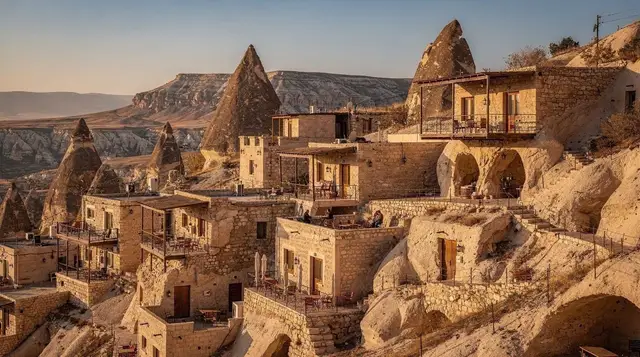
The cliff above Çavuşin is tuff, the same soft volcanic rock that makes up most of the region’s fairy chimneys and cave dwellings, carved and re-carved by generations of families into a stacked warren of rooms, stables, and storage cellars. From below, the facade reads as rows of dark doorways and window openings, some rectangular and clearly cut by hand, others ragged where a chamber has partly collapsed and opened itself to the sky. Pigeon holes — small square niches cut in clusters — pepper large stretches of the rock; pigeon droppings were collected as fertiliser here for centuries, and dovecotes like these turn up across the region, including at Uçhisar and in the valleys around Ürgüp.
Walk up on the marked paths and you can step into several of the lower houses. Inside, the rooms are simple: niches cut for storage, soot-blackened ceilings from decades of cooking fires, the odd carved cupboard or manger where livestock were once kept on a lower level while people lived above. There’s no furniture, no signage inside the rooms, nothing curated — this isn’t a museum display, it’s an empty building left as it was when the last people moved out. That plainness is part of what makes it worth the stop: it’s a lived-in place with the life removed, not a reconstruction.
Why it was abandoned
Çavuşin’s cliff face is unusually soft and fractured even by Cappadocian standards, and it has a long history of partial collapses. As sections of the rock face gave way through the middle of the twentieth century, houses were damaged or made unsafe, and families gradually relocated to sturdier ground at the base of the hill — the modern village you pass through today.
It wasn’t a single dramatic evacuation so much as a slow abandonment, house by house, as the cliff kept shedding rock and living up there stopped being worth the risk. The pattern echoes what happened a few kilometres away at Zelve, which was evacuated more formally in 1952 for the same underlying reason: soft rock, steep faces, and buildings that eventually stop being safe to inhabit.
What’s left is a hillside frozen partway through that decline — some sections still structurally intact and walkable, others clearly mid-collapse, chunks of facade missing, rooms opened up to the weather. It’s this half-finished quality, more than any single building, that makes the site interesting: you’re looking at erosion and abandonment as an ongoing process rather than a finished ruin.
What’s open, and what isn’t
This is the point worth taking seriously. The lower tier of the old village, closest to the road, is accessible on foot via informal but clearly worn paths, and this is where most visitors go — into two or three of the more intact houses, along a short stretch of the cliff base. Beyond that, higher galleries and the most visibly damaged sections are fenced or simply left without any path at all, and that’s a deliberate signal, not an oversight. Rock that has already collapsed once is not a reliable surface to climb over, and sections that look stable from below can be hollow, cracked, or sitting on rock that’s already failed elsewhere in the same cliff.
Don’t treat the absence of a ticket booth as an absence of risk. There’s no ranger stationed here the way there is at the Göreme Open-Air Museum, which means there’s also no one to stop a determined visitor from scrambling past a barrier — and every year a handful of people do, usually chasing a better photo angle. Stay on the worn paths, don’t put weight on ledges or doorframes to climb higher, and treat any fenced or roped-off section as closed, not as an inconvenience to route around. The same caution applies generally across the region’s cave sites — see the hiking safety guide for what applies more broadly to walking on Cappadocia’s tuff.
Getting there and the view from below
Çavuşin sits about 5 minutes from Göreme by car, dolmuş, or a determined walk along the road, and the old village is unmissable once you’re in the modern village — it’s the cliff directly above the main street and the car park near the church. You don’t need to leave the road to appreciate the scale of it: from the small square at the base, the whole tiered facade is visible in one sweep, and this is genuinely the best vantage point for photographing the cliff as a whole, rather than individual houses.
If you’re driving yourself, there’s informal parking near the village centre within a couple of minutes’ walk of the base of the cliff. Dolmuş services connecting Göreme, Avanos, and the villages in between run frequently during the day but thin out in the evening, so this isn’t a site to plan as a sunset stop unless you already have a car or a taxi arranged for the way back.
Walking up: what to expect
The paths into the lower village are unpaved, uneven, and dusty in dry weather — closed shoes are worth having even for a short visit, and the same applies here as everywhere else on the region’s tuff: there’s very little shade, so a visit in the middle of a summer afternoon is more draining than it looks for a 20-minute stop. Twenty to forty minutes is enough for most people: time to walk along the accessible facade, step into two or three houses, and take photographs from a few angles before moving on. There’s no route that loops back a different way — you go up, look around, and come back down the way you came.
It’s a good pairing with Çavuşin’s Church of St John the Baptist below, one of the oldest churches in the region, and with the general walking guide to Göreme if you’re building a longer morning on foot rather than by car. For a broader sense of where this site sits among the region’s other lookout points, the viewpoints guide covers several others within a short drive.
Old village, church, and modern Çavuşin — not the same stop
It’s easy to conflate the three, since they sit stacked on top of each other, but they’re distinct enough to plan separately if you’re short on time.
| Site | What it is | Ticket | Typical time |
|---|---|---|---|
| Old village (this page) | Abandoned cliff of empty cave houses above the modern village | Free, view from paths and road | 20–40 minutes |
| Church of St John the Baptist | One of the region’s oldest rock-cut churches, built into the same cliff | Usually a small separate ticket | 15–20 minutes |
| Modern Çavuşin village | The working settlement at the base — shops, a couple of cafés, houses still lived in | Free | As long as you like |
If you’re pressed for time and have to choose, the old village’s cliff face is the more visually striking of the three and needs no ticket, which makes it an easy add-on even to a day that’s otherwise built around other sites.
Combining it with a Red Tour day
Çavuşin’s old village isn’t sold as a stop on its own by local agencies, but it sits directly on the route most of them use for the northern circuit — the loop that also covers Paşabağ, Zelve, Devrent Valley, and Avanos. If you’d rather not self-drive, the Red Tour, which loops through this stretch of the north before finishing near Avanos passes close enough that a short stop at the old village fits naturally either side of it, even if it isn’t on the printed itinerary.
Travellers who prefer walking with a guide over a minibus circuit sometimes fold a look at Çavuşin into a guided valley-hiking day that covers a different stretch of terrain nearby, using it as a short detour before or after. And if you’re staying in the village overnight specifically to watch the sunrise skyline, a dawn balloon flight over this part of the region gives a view of the same cliffs from above that’s impossible to get on foot — though you can also just watch from the road with a coffee, at no cost, if flying isn’t the plan.
Photography and light
The cliff faces roughly toward the village square, which means the facade catches good angled light in the early morning and again in the last couple of hours before sunset — the same window that works for most of the region’s rock formations. Midday sun hits the face nearly head-on and flattens the shadows that give the pockmarked rock its texture, so if photography is the main reason for the stop, it’s worth timing it outside the middle of the day. There’s no restriction on photography anywhere on the accessible paths or from the road, and no fee attached to it.
Practical notes before you go
There’s genuinely very little to plan here — no tickets, no opening hours to check, no booking. The only real preparation is footwear (closed shoes, given the loose and uneven ground), water if you’re combining it with a longer morning in the sun, and treating the fenced sections as a firm boundary rather than a suggestion. Bring a torch or your phone’s light if you want to look into the darker rooms; none of the interiors are lit.
Beyond that, it’s the kind of stop that works better as part of a bigger loop than as a destination in its own right. Pair it with the church below, with Paşabağ and Zelve a short drive north, or with a wider first day in the region using the one-day Cappadocia itinerary or the general first-timer’s guide to seeing the region in one day as a starting frame. Anyone travelling with limited mobility should note there’s no accessible route up into the cliff itself, though the view from the square below needs no walking at all — see the guide to Cappadocia with limited mobility for how that plays out across the region’s other sites.
Questions about visiting Çavuşin’s abandoned old village
Can you go inside the old cave houses at Çavuşin?
Some of the lower facades are open to walk up to and step inside, following marked paths from the road. The upper tiers and the sections closest to past rockfalls are fenced off, and staff or signage discourage climbing beyond them because the rock is unstable.
Is there an entrance fee for Çavuşin’s old village?
No. Unlike the Göreme Open-Air Museum or Zelve, there’s no ticket booth for the old village. You view it from the road below or walk up on the open paths, at no cost.
How is this different from the Çavuşin church and the village below?
The old village is the abandoned cliff of empty cave houses above the modern settlement. The Church of St John the Baptist and the working village with its shops and cafés sit at the base of the cliff and are a separate, still-inhabited place, covered on its own page.
How long does it take to see the old village?
Most travellers spend 20 to 40 minutes: enough to walk the lower paths, look into a handful of houses, and take photographs from a couple of angles. It’s rarely a stop on its own — most people fold it into a longer morning.
Is the climb up to the old village safe?
The marked lower paths are manageable for anyone reasonably fit, though the ground is uneven and dusty. The unsafe part is what lies beyond the markers: unstable galleries and facades where rockfalls have happened before and could happen again. Stay on the paths and don’t cross barriers.
Can you combine it with Paşabağ, Zelve and Devrent in one day?
Yes — all four sit within about 15 minutes of each other and this is broadly the route the locally sold Red Tour follows. On a self-drive day, Çavuşin’s old village works well as a quick first or last stop either side of the longer visits at Zelve and the museum.
Is Çavuşin’s old village good for photography?
Yes, particularly in low-angle light, when the pockmarked facades and pigeon holes throw long shadows. Midday sun flattens the texture that makes the site worth photographing. There’s no restriction on photography from the paths or the road.
Is it suitable for visitors with mobility issues?
Viewing from the road at the base of the cliff needs no walking beyond a car park. Going up into the old houses themselves involves uneven, sloped ground with no railings, which won’t suit everyone. There isn’t a paved or step-free route into the cliff itself.