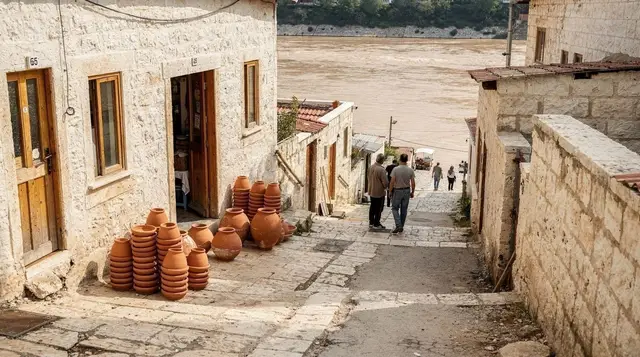
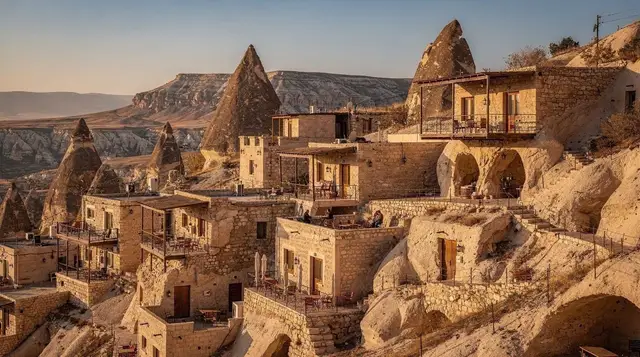
A different kind of Cappadocia landscape
Almost everything described in guides to Göreme and its valleys shares one origin story: tuff spat out by Erciyes and Hasan Dağı, tens of thousands of years ago, later carved by wind and rain into the fairy chimneys, cave churches and underground cities that define the region. Acıgöl doesn’t belong to that story. It’s a crater lake — a maar, in geological terms — punched into the plateau by a separate and more localised volcanic event, and it looks like nothing else on this site’s destination list. There are no fairy chimneys here, no cave dwellings, no rock-cut churches. There’s a steep-sided crater holding a body of water, open sky, and very few other visitors.
That difference is exactly why this page exists, and also why it comes with a caveat: Acıgöl sits well south-west of the Uçhisar–Nevşehir cluster that most Göreme-based itineraries are built around, tucked in on the road towards Aksaray rather than anywhere near the valleys, museums or underground cities. It isn’t a stop you tack onto a morning at Uçhisar or an afternoon in the Göreme Open-Air Museum. It’s its own small excursion, and it makes far more sense paired with Aksaray or Güzelyurt than bolted onto a day already built around cheminées de fées.
Where Acıgöl sits, and why it isn’t an easy add-on
Acıgöl is a small town and a lake of the same name, positioned south-west of Nevşehir, on the road that continues on towards Aksaray. From Göreme, that’s roughly 45 to 60 minutes by car, depending on the route and how far past Nevşehir the lake actually sits — noticeably further than the 15-to-20-minute hops to Uçhisar, Ürgüp or Avanos that make up most day-one itineraries. From Aksaray, by contrast, it’s a much shorter run, well under half the driving time it takes to reach Aksaray from Göreme itself.
That geography matters for planning. Most Cappadocia day trips radiate outward from Göreme in a rough wheel: the northern valleys and Avanos in one direction, the underground cities and Ihlara Valley in another, Ürgüp and the wine country in a third. Acıgöl sits off that wheel entirely, closer to the axis running towards Aksaray and Konya than to anything a typical two- or three-day Göreme itinerary covers. It’s the kind of place that gets visited by people who are already driving that corridor — heading to or from Ihlara Valley, Güzelyurt, or further south towards Konya — rather than a stop anyone plans a dedicated round trip around from the Göreme side.
If your time in Cappadocia is genuinely limited to the valleys, museums and balloon flight that most visitors come for, Acıgöl is easy to skip without missing anything essential. If you have a rental car, an extra half day, and an interest in the region’s volcanic history beyond the tuff that gets all the attention, it earns its place.
What the maar lake actually looks like
Visually, Acıgöl reads as landscape rather than monument. The crater itself is a wide, roughly circular depression with steep inner slopes, holding a body of water at the bottom. There’s no ancient church carved into a cliff face here, no chapel with faded frescoes, no chimney with a double cap balanced on top — the appeal is purely in the geology and the openness of the view. Standing on the rim, you look down at water encased in rock rather than out across a valley of eroded columns, which is a genuinely different visual experience from anywhere else covered on this site.
The setting is open and largely treeless, which means strong light and long sightlines but very little shade. It’s a landscape built for looking rather than wandering — there isn’t a network of paths and side-valleys to explore the way there is at Rose Valley or Pigeon Valley, and nobody should come expecting a half-day hike. It’s closer in spirit to a scenic overlook than to the walkable valleys around Göreme, and it rewards a slower, quieter visit rather than a checklist stop.
Geology: how Acıgöl differs from the tuff valleys
The region’s signature landscape — the peribacaları, or fairy chimneys — formed when thick layers of volcanic ash and tuff, erupted over a long span by Erciyes and Hasan Dağı, were compacted and then slowly eroded by wind and rain, leaving softer rock stripped away around harder caprock. It’s a story of accumulation followed by gradual erosion, playing out over the entire plateau.
Acıgöl formed differently. A maar is a crater created by a relatively sudden, explosive interaction between rising magma and groundwater — a phreatomagmatic explosion, in geological terms — rather than by the slow build-up of ash layers that later eroded into columns. The result is a bowl-shaped depression rather than a landscape of standing pillars, and over time that bowl has filled with water. It’s a single, localised volcanic feature rather than a valley shaped by millennia of weathering across a wider ash deposit.
The table below sets out the contrast plainly, because it’s easy to assume every striking landform around Nevşehir shares one origin.
| Cappadocia’s tuff valleys (e.g. Rose Valley, Zelve) | Acıgöl | |
|---|---|---|
| Formation | Ash and tuff from Erciyes and Hasan Dağı, compacted then eroded over millennia | A single volcanic maar crater, filled with water |
| What you see | Standing rock columns, cave dwellings, rock-cut churches | An open crater rim and a lake |
| Typical activity | Walking between formations, visiting churches or troglodyte sites | Viewing the crater and lake from the rim or shore |
| Crowds | Heavy at popular valleys, especially mid-morning to mid-afternoon | Very light |
| Distance from Göreme | 5–20 minutes for most sites | 45–60 minutes |
For anyone piecing together how the region’s volcanoes actually shaped what tourists see today, this explainer on the volcanoes behind Cappadocia and a closer look at Erciyes itself fill in the picture that Acıgöl only partly represents on its own.
Who actually goes there
Acıgöl draws a narrower crowd than almost anywhere else covered on this site, and it’s worth being honest about who that is. It appeals to travellers with a specific interest in volcanic geology, to photographers looking for open landscape rather than the closed-in feel of a valley or cave church, and to people who are already driving the Aksaray–Nevşehir road and would rather stop at something real than push straight through. It does not particularly appeal to first-time visitors trying to see the region’s headline sights in two or three days, families looking for an easy half-day activity, or anyone expecting facilities, guided interpretation, or a curated visitor experience.
That’s not a criticism of the site — it’s simply a different kind of destination from the museum-and-monument stops that dominate most Cappadocia itineraries, and setting expectations accordingly avoids disappointment. If your trip is built around seeing Cappadocia without joining an organised tour, Acıgöl is a natural fit for a self-drive day. If you’re relying entirely on shared tours and dolmuş connections, it’s a harder place to reach and probably not worth the logistics.
Getting to Acıgöl
There’s no direct dolmuş service built for casual sightseeing at the lake, and no tour company runs it as a headline stop the way Red, Green or Blue Tour operators run the valleys and underground cities. In practice, three approaches work:
| Method | Notes |
|---|---|
| Self-drive rental car | The most flexible option; see car rental in Cappadocia for what to expect on the road |
| Private driver or guide | Worth it if you want Acıgöl folded into a wider loop through Aksaray or Güzelyurt without doing the navigation yourself |
| En route to/from Ihlara, Güzelyurt or Konya | If you’re already covering that corridor, a short detour to the lake adds relatively little extra driving |
A private full-day tour with hotel pickup can be built around a route like this if you’d rather not navigate the Aksaray road yourself — most operators will adjust the stops on request rather than sticking to a fixed valley circuit. For travellers who’d rather handle the driving independently, a self-drive explorer pass covers a flexible rental that works just as well for a detour like this as it does for the sights it’s usually booked for.
What to combine it with
Because Acıgöl sits off the main Göreme-centred grid, the sensible approach is to fold it into a day that’s already heading in that direction rather than treat it as a stand-alone trip. The most natural pairings:
- Aksaray and Güzelyurt. Both sit close to Acıgöl along the same corridor, and a day covering Aksaray and Güzelyurt together with the crater lake makes a coherent, low-crowd loop. The dedicated Aksaray and Güzelyurt day trip guide lays out a fuller route.
- Ihlara Valley. If you’re already driving out to Ihlara Valley for the canyon walk, Acıgöl can sit at the start or end of that day, though it will stretch what’s already a fairly full outing.
- Salt Lake (Tuz Gölü). The two lakes are unrelated geologically and sit a considerable distance apart, but travellers curious about the plateau’s water features sometimes combine both into one longer day. See the Salt Lake day trip guide before committing to that combination, since it makes for a long day on the road. A packaged option covering some of this ground is the Salt Lake and underground cities day tour with lunch, though it’s built around Tuz Gölü and the underground cities rather than Acıgöl specifically, so check the itinerary before booking if the crater lake is the point of the day.
What doesn’t work well is squeezing Acıgöl into a day that already includes the northern valleys, the Göreme Open-Air Museum, or Uçhisar. The driving direction is wrong and the pacing doesn’t fit — those sights sit north and east of Nevşehir, while Acıgöl sits south-west, on the way to Aksaray.
Practical notes
There’s little shade at the crater rim, so bring water and sun protection regardless of season, and treat a midday summer visit as genuinely uncomfortable rather than merely warm. The path along the rim is unpaved and can be uneven in places, so closed shoes are worth the small effort of packing them even for what looks like a short stop. Facilities at the lake itself are minimal to non-existent — this isn’t a site with a visitor centre, ticket booth or café, so plan to eat in Nevşehir or Acıgöl town rather than at the water’s edge.
Mobile signal is generally fine along the main road but can weaken near the crater itself, so it’s worth downloading offline maps or confirming directions before setting off, particularly if you’re self-driving and haven’t done much independent driving in Cappadocia before. There’s no swimming beach, no boat rental, and no organised water activity here — treat the lake as a viewpoint rather than a place to get in the water.
For a wider sense of what actually rewards a viewpoint stop across the region, from crater rims to valley overlooks, the Cappadocia viewpoints guide puts Acıgöl in context alongside better-known spots like the Göreme panorama and Uçhisar castle.
Acıgöl: questions before you go
Is Acıgöl worth the detour from Göreme?
Only if geology interests you or you’re already driving towards Aksaray or Güzelyurt. It’s not a fairy chimney site, there’s no museum ticket to buy, and it won’t fit neatly into a day built around the Göreme valleys.
How do you get to Acıgöl without a car?
There is no dolmuş route built for casual sightseeing at Acıgöl. Realistically you need a rental car, a private driver, or a tour that already routes through the Nevşehir–Aksaray corridor.
Can you swim in Acıgöl?
This guide doesn’t promise organised swimming or boating at the lake. Treat it as a viewpoint and a geological stop rather than a beach day, and don’t expect facilities.
Is Acıgöl the same as Tuz Gölü, the Salt Lake?
No. Tuz Gölü is a large, shallow salt lake much further south, usually visited as its own long day trip. Acıgöl is a small, deep crater lake formed by a volcanic maar, and the two are unrelated beyond both holding water on the Anatolian plateau.
How long do people spend at Acıgöl?
Most visitors spend one to two hours at the crater rim and the lakeshore. Add the drive from Göreme and it becomes a half-day outing rather than a quick stop.
What’s the best time of day to visit?
Early morning or late afternoon, for softer light and cooler air on the open crater rim. Midday in summer is exposed and hot, with almost no shade.
Is there anywhere to eat near Acıgöl?
The town of Acıgöl and nearby Nevşehir have ordinary local restaurants, but nothing set up for tour groups. Most visitors eat before or after the stop rather than at the lake itself.