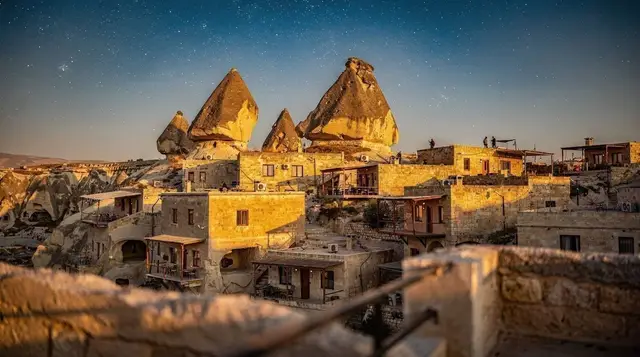
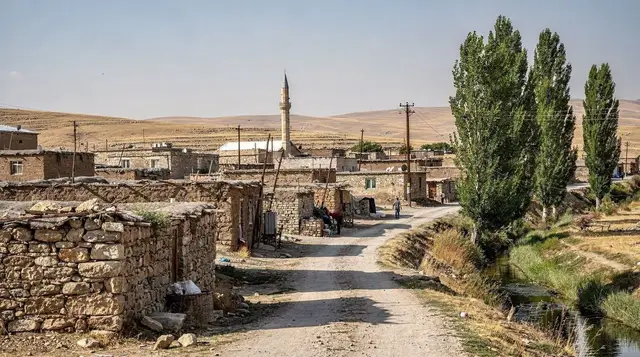
Mustafapaşa: the Cappadocia town that used to be Sinasos
A street of doorways with nobody’s name on them
The first thing I noticed in Mustafapaşa wasn’t a monument. It was a doorway — deep-set, carved with vines and a lintel someone had clearly paid a stonemason to get right — on a house that now sells nothing, announces nothing, and belongs to no one I could ask about. That’s the whole town, more or less. Row after row of stone facades built by people whose names aren’t on them anymore, because in 1923 those people were moved out of the country by government agreement, not by choice, and never came back.
Mustafapaşa is a 20-minute drive from Göreme, and it gets a fraction of the visitors that Ürgüp does, let alone Göreme itself. If you’ve read anything about the Red, Green and Blue tour circuits, you’ll know why: it isn’t a standard stop on any of them. Most people doing an organised day out never see it. I think that’s a mistake, but not because the village is spectacular — it isn’t, particularly. It’s a mistake because the story behind it is one of the more concrete pieces of history you can actually stand inside in this region, and it gets skipped for sites that photograph better.
What the name change tells you
Before it was Mustafapaşa, this town was called Sinasos. It was Greek-Orthodox, and it had been for a long time — long enough that its wealthier families had the means to build houses with genuinely fine stonework, the kind you don’t put up on a house you expect to leave. Some of that money came from Sinasos families who’d made fortunes in Istanbul and sent it home to build. You can still see the results: carved door frames, worked stone facades, details that took real skill and real time.
Then, in 1923, the town emptied. Not gradually, and not because people decided the economy had turned or a war had made life difficult. It emptied because Greece and Turkey signed an agreement — part of the settlement that followed the Greek-Turkish war — for a compulsory population exchange, sorted by religion rather than language or birthplace.
Orthodox Christians across Anatolia, Sinasos included, were required to leave for Greece; Muslims living in Greece were required to move to Turkey. It didn’t matter that many of Cappadocia’s Orthodox families spoke Turkish as their first language and had done for generations. Religion was the line the states drew, and it was final. Families who had lived in these houses for generations were given a matter of months.
That’s the detail worth sitting with when you’re standing on the street in Mustafapaşa: this wasn’t an exodus that happened because life became too hard, in the way people usually leave a place. It was a state decision, applied to people who had no vote in it, with a deadline attached. I find that distinction easy to state and harder to actually hold onto until you’re looking at a specific carved door that a specific family built and then were told to leave behind.
What’s left standing
What makes Mustafapaşa worth the detour, for me, is that so much of the physical evidence is still there rather than cleared away or rebuilt over. The stone houses are the clearest part — facades with carved vines, rosettes, lintels worked by people who intended to stay. Walking the streets, you’re looking at genuine Sinasos architecture, not a reconstruction.
The religious buildings are the other half of it. Former Greek-Orthodox churches remain in the town, some reused, some simply left standing rather than torn down — a different fate from a lot of places where a departed community’s buildings just disappear over the following decades. You won’t get the painted interiors or the crowds of the cave churches around Göreme; this is a different kind of site, built to be stood in and lived around rather than filed for tourists, and it shows.
If you want the fuller walk-through of specific buildings and streets, there’s a dedicated guide to Mustafapaşa and Sinasos that goes into more detail than a personal account like this one should. What I’d add from actually being there is that nothing is explained loudly. There’s no large interpretive panel translating the whole history for you at the entrance to town. You have to already know what you’re looking at, or bring the story with you.
Why I’d send you here instead of another valley
Most first-time visitors spend their limited days on the balloon flight, the open-air museum, and a Red or Green Tour, and that’s a reasonable way to see Cappadocia’s landscape. I did the same thing on my first morning — a sunrise balloon flight over Göreme is a genuinely different way to understand the valleys, and I don’t regret booking it early. But a landscape and a specific human history are two different things to go looking for, and Cappadocia has more of the second than the standard circuit lets on.
If you’re taking one of the organised routes, a guided Red Tour with lunch included will show you the fairy chimneys and the open-air museum well, but it won’t take you to Mustafapaşa — that isn’t on the route. The way I’d actually see this town properly is with a private guide who can go off the fixed circuit, because a fixed-departure bus simply doesn’t stop here.
It’s also worth combining with nearby villages that share pieces of the same regional story, like Taşkınpaşa, Cemil and Ayvalı, or the carved rock formation at Three Beauties if you’re passing that way. None of them require a full day on their own, so they slot in well around a base in Ürgüp, where you can also stop for wine at one of the old cellars or find somewhere decent to eat afterwards.
If you’re building your own route rather than booking everything, our notes on seeing Cappadocia without a tour cover how to fit a stop like this into a rental car day, and a two-day itinerary is enough time to include it without cutting anything essential.
I don’t think Mustafapaşa needs to be sold as a highlight, and I’d be uncomfortable if it were. It’s a town where a community was removed by state decision within months, and what’s left is the physical record of people who expected to stay. That’s reason enough to walk it slowly, read the doorways properly, and not treat it as one more site to check off between the balloon flight and dinner. If you want pottery and a working craft tradition rather than absence, Avanos is twenty minutes further on and makes a fair contrast for the rest of the day.
Questions about visiting Mustafapaşa and Sinasos
What was Mustafapaşa called before 1923?
Sinasos. It was a Greek-Orthodox town in Cappadocia, built up by wealthy Orthodox families whose money shows in the carved stone facades that still line the streets.
Was the population exchange voluntary?
No. It was a compulsory exchange agreed between the Greek and Turkish states, not a series of individual decisions to leave. Residents did not choose to go, and the timeline gave them almost no room to prepare.
What can I actually see in Mustafapaşa today?
Stone houses with carved doorways and facades built by Sinasos’s Orthodox families, and former religious buildings that have been reused or left standing rather than demolished. Nothing is staged for visitors; it is simply what remains.
How is Mustafapaşa different from Göreme or Ürgüp?
It is quieter and it is not built around cave hotels or valley walks. The reason to go is the specific history of the town, not another set of fairy chimneys or rock-cut churches.
Is Mustafapaşa on the standard Cappadocia tour circuit?
Not on the Red or Green tours, which is why most visitors on organised day tours never pass through. It sits closer to the quieter southern routes, so it usually has to be a deliberate stop rather than something you happen upon.
How long should I plan for a visit?
An hour is enough to walk the main streets and look at the facades properly; two hours if you want to sit down for tea and read the history rather than rush it.
Is Sinasos worth visiting if I’ve already done the Göreme Open-Air Museum?
Yes, but for a different reason. The Open-Air Museum is about painted cave churches from the tenth and eleventh centuries. Mustafapaşa is about a specific, comparatively recent event and what a forced departure leaves behind in a place people actually lived.
tours.History
Verified deep-linked GetYourGuide tours. Book through these links and we earn a small commission at no cost to you.
GetYourGuide does not provide a product photo for this activity — the image shows the meeting point, photographed by us.